
Woman, Viewer, Subject, Object: The Faces of Lynn Hershman Leeson
Lynn Hershman Leeson defies categorisation. Her artworks are sketched, photocopied, filmed, sculpted, broadcast, cut and pasted. They are encased in glass, tucked beneath blankets, animated by sound. They visit the California Department of Motor Vehicles and submit application forms for driving licences. They meet suitors for dates in San Francisco’s Union Square, wearing blonde wigs and Revlon blush. This vast and varied body of work, made from the early 1960s to the present day, seems impossible to characterise neatly. Except, that is, to say this: that women are Hershman Leeson’s medium. Not ‘woman’ merely as artistic subject, nor ‘womanhood’ as theme, but the use of women as material—their bodies, faces, identities. Women as the stuff of the art itself, whether sketched, filmed, photocopied, or filling out forms at the DMV.
Just as Hershman Leeson’s methods have varied over the decades, so too has her conceptual terrain. Her work explores surveillance, mass media, voyeurism, cyborgism, cloning, identity, and reality versus the virtual or fictional—often in remarkably prescient ways. Yet these subjects, while wide-ranging, aren’t an array of discrete concerns. Rather, each links to the rest, one thematic concern elucidates another. We might think of Hershman Leeson’s themes as nodes in a network: every artwork a vector, tracing the connection from, say, identity to cloning, or from surveillance to the cyborgian.
And, when we take this network as a whole, we find that one of the things the artist is doing again and again through her recurring use of women is interrogating the relationship between artwork and viewer, between subject and object. Which is to say: the visitors, audiences, viewers, and users interacting with Hershman Leeson’s work are as much the artist’s media as the women sketched and sculpted. Which is to say: you are her media, too.
→ THE WOMAN IS CYBORG →
Born in 1941, Hershman Leeson began making art during her childhood: drawings, collages, and paintings. In her adolescence, the focus of these works settled almost exclusively upon women. From the mid-1960s, these figures were depicted on paper, cardboard, and canvas as bio-mechanical hybrids. In works like Zipping in Cyborg (1963) and X-Ray Woman (1966), Hershman Leeson sketched out line drawings of women, laying their innards bare for the viewer like anatomical illustrations. Certain organs are highlighted with coloured acrylic and watercolour, and these organs are formed not only of flesh and bone but cogs, levers, and clocks. A few years later, Hershman Leeson began, in the titles of her works, to explicitly identify such figures as cyborgian—as in Cyborg with a Heart Transplant (1968). Hybrid processes echoed her hybrid human-machines. She screwed metal and plastic to paper, and realised, after a photocopier malfunction, that she could also mark-make with technology. When Hershman Leeson scrunched up her drawings then pushed them through the machine, the resulting creases would be accentuated in ink; the image was ripped, deformed, and made anew.
The figure of the cyborg now conjures a certain bygone, futurist aesthetic, dating from around The Terminator (1984) and Donna Haraway’s ‘A Cyborg Manifesto’ (1985) to the turn of the millennium.The turn of the millennium saw a resurgence of feminist interest in the cyborg within technofeminist and cyberfeminist thinking. See, for example, Sadie Plant, Zeroes and Ones: Digital Women and the New Technoculture (1997), and Judy Wajcman, TechnoFeminism (2004).But the notion of mechanically enhanced humans is far older than this, going back to at least the nineteenth century, and the term (‘ cyb ernetic’ + ‘ org anism’) was coined in 1960.Manfred E. Clynes and Nathan S. Kline, ‘Cyborgs and Space’, Astronautics (September 1960), p. 26–27 and 74–76. Earlier examples of human-machine hybrids can be found in science fiction, see: Edgar Allen Poe, ‘The Man That Was Used Up’ (1843), E.V. Odle, The Clockwork Man (1923), and C.L. Moore, ‘No Woman Born’ (1944).In 2009, Hershman Leeson explained she ‘didn’t know what prompted’ her exploration of the cyborgian, beyond enjoying the process of using a Xerox machine. More generally, she added, the ‘mechanics and process of living’ were central to her thoughts at the time.‘Lynn Hershman Leeson in conversation with Gabriella Giannachi’, Leonardo , 43:3 (June 2010), p. 232.
Hershman Leeson’s women were machines—and what are machines but objects invented to perform certain tasks? Between the cogs and sparks, X-Ray Woman has a womb, nesting three babies: her output, as machine. Yet a cyborg is also human, and she retains her autonomy. We can see this in Hershman Leeson’s drawings too. X-Ray Woman stands defiantly with hands on hips, staring back at the viewer. The cyborg, as Sadie Plant writes, is ‘both the steersman and the ship.’Plant, Zeroes and Ones , p. 156. In making this point, Plant was drawing on Norbert Wiener, Cybernetics or Control and Communication and Control in the Animal and the Machine (1948). In the 1960s, Hershman Leeson wasn’t yet foregrounding her exploration of the subject-object relationship, but retrospectively we can see it emerge from this female-mechanical hybridity.
To some of these early collages, over the faces, Hershman Leeson affixed mirrors.
→ THE CYBORG IS SEEN →
Around this time, during a pregnancy, the artist was diagnosed with cardiomyopathy. As a result, she developed breathing problems and was confined to an oxygen tent for months. During recovery, Hershman Leeson attended a wax casting class and began replicating her face. Then, as she regained control of her breathing, she added sound to these sculptures. In her Breathing Machines series (1965–69) Hershman Leeson painted disembodied, three-dimensional wax casts of her face with makeup, dressed them in wigs, encased them in glass. When approached, a sensor concealed in the sculpture would trigger an audiotape recording: in this way, the wax faces breathed, giggled, spoke, or coughed. Brought to life, they became cyborgs too.
How autonomous these Breathing Machines are might be a matter of perspective. We could point to the fact that the viewer conjures the artwork to life. The sculptures are machines: objects designed to perform a particular task.
Or we might note that the viewer’s motion is part of the artwork—just as, through the use of mirrors, Hershman Leeson incorporated the viewer’s image into collage. By activating the sensor, the viewer is performing a particular task as designed. Does the human control the machine or vice versa?
A machine is called upon to perform a certain task; a certain action is called upon to wield the machine.
→ THE SCENE IS A FICTION →
The Breathing Machines were first exhibited at the Berkeley Art Museum, as part of a group show in 1972. But before installation, Hershman Leeson was asked by the museum’s director to show only her drawings and not her sculptures. The curators insisted, in Hershman Leeson’s account, that ‘sound media was not appropriate material for an art museum’.Lynn Hershman, ‘Private I: An Investigator’s Timeline’ in The Art and Films of Lynn Hershman Leeson , ed. Meredith Tromble (London, 2005), p. 23. When the artist refused and installed her Breathing Machines regardless, the works were only displayed for two days before curators removed them. And so Hershman Leeson turned from galleries to exhibit elsewhere.
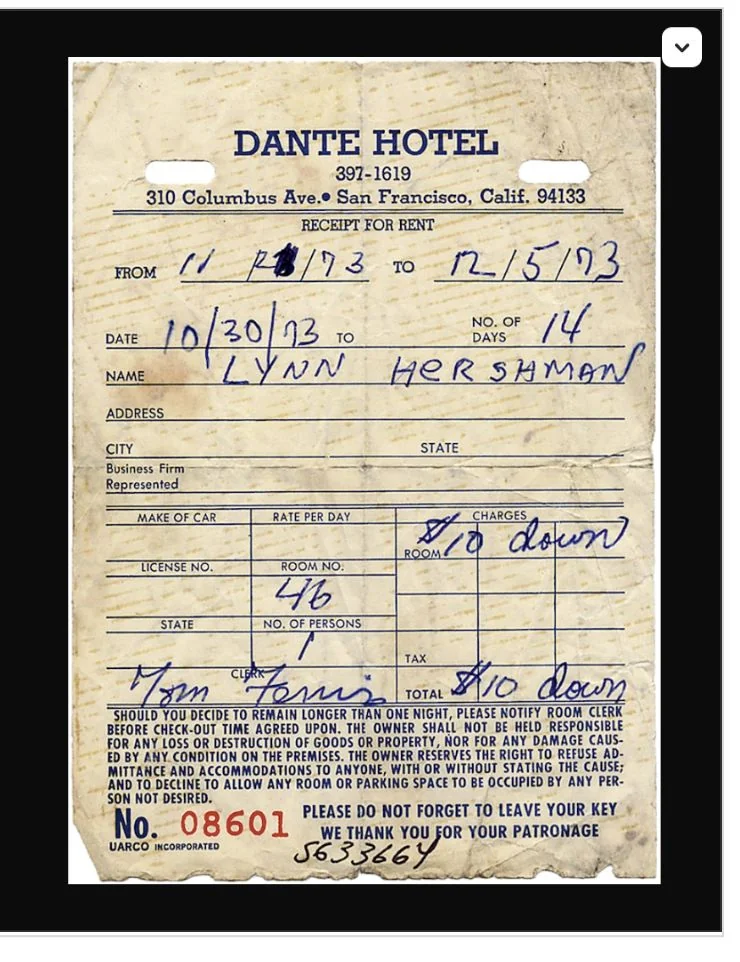
In late 1973, she rented two rooms at the Hotel Dante, a seedy joint in North Beach, San Francisco, with Eleanor Coppola (Hershman Leeson had met the director, writer, and artist when organising a carpool for their children). In their respective rooms, each installed their own work: Hershman Leeson in room 47, Coppola in room 43. Coppola hired friend and actor Tony Dingman to live in her room and be observed by visitors. This installation ran for a week, where Hershman Leeson’s was intended to run indefinitely.
Adverts were placed in local papers:
HOTEL DANTE Lynn Hershman N° 47 PERMANENTLY 310 COLUMBUS open 24hrs
It wasn’t clear from this wording exactly what was being advertised. Certain readers would have recognised the artist’s name and understood it as some kind of show, where others may have simply found the cryptic copy and the woman’s name intriguing. Either way, what did visitors expect to find as they signed at reception, collected the room key, and climbed the stairs?
Behind door 47, the visitor would discover two women lying in bed, sheets rumpled, the sound of snoring. Various objects were strewn about the place: clothes, books, cosmetics; a radio blared. On the dresser mirror, scrawled in lipstick, were a heart and an eye, as well as a message: ‘I LOVE YOU Drop dead! c u later’.
What may have initially appeared to be an ordinary occupied hotel room revealed itself as something else on closer inspection. Like the patch of wallpaper just above the bed—at first glance, quite conventional, but then, no: the visitor would realise that its pattern had been created from repeated photographs of the very scene in which the visitor stood. As for the bodies in the bed, the visitor would soon realise they were motionless. These women were not alive but dolls—wax casts taken from the artist’s own face, their snores emanating from a hidden cassette.
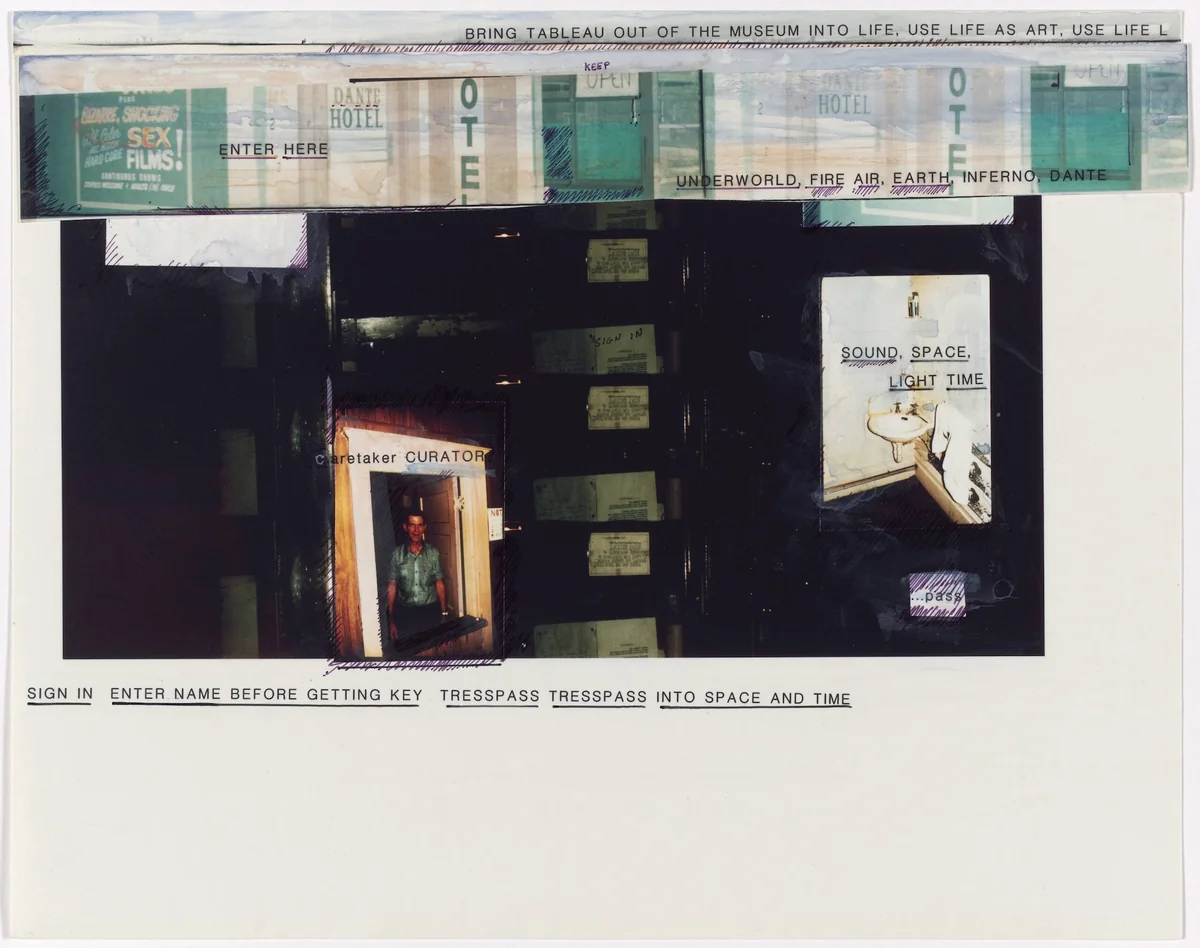 © Lynn Hershman Leeson This was Hershman Leeson’s installation, The Dante Hotel, and everything in room 47 had been carefully staged to suggest to the visitor a woman’s presence. The birth control pills, the Tampax, the toothbrushes, were all clues which functioned much like the motion sensors in Breathing Machines. Just as the motion sensors had waited for the viewer to trigger speech or laughter, so the women in the bed waited for the visitor to endow them with story. The art was only brought to life by a viewer. ‘The act of observation,’ Hershman Leeson explained, ‘was an implicit part of each character’s construction. The fictional occupants of the Dante Hotel were trapped, encased with their artefacts for witnesses to discover.’Ibid ., p. 33.
Yet, unlike Breathing Machines, here the viewer physically entered the artwork. And they could engage with it however they chose, whether via a quick glance or careful investigation. They could touch the items, alter the scene. Some may have left immediately, worried they had stumbled upon two sleeping hotel guests. Others must have dwelled a while, trying to piece together the clues.
All of the women’s ‘personal’ belongings had been found by Hershman Leeson in the neighbourhood and chosen to represent ‘somebody who might have lived in that room’.Lynn Hershman Leeson interviewed by Patricia Maloney in ‘Looking for Roberta Breitmore’, Art Practical (12 April 2011). That room: just the kind of shabby, transient place a down-and-out character in 1970s San Francisco might find themselves. North Beach was also home to peep-shows and striptease clubs; one contemporary critic described Hotel Dante as sitting at the ‘historical and geographic epicenter of Nipple City’.James Minton, ‘Trespassing at the Dante’, Artweek 22–29 (December 1973), p. 3. Quoted in Milena Tomic, ‘Biopolitical Effigies: The Volatile Life-Cast in the Work of Paul Thek and Lynn Hershman Leeson’, Tate Papers 24 (Autumn 2015).
The artist left the visitor to draw their own conclusions. One reading might lead us to think of parallels between the figures in the bed, watched by visitors to the Hotel Dante, and the real women on show as they worked a few doors down. These real women had once fashioned their own identities using the very same objects as those placed in Room 47: the discarded clothes, cosmetics, magazines, and spent cigarette butts which the artist had gathered from the surrounding streets.
Hershman Leeson also placed, within the room, two goldfish in a bowl.
 → THE FICTION IS A WOMAN →
The Dante Hotel stayed open for nine months, accumulating dust until one late-night visitor, believing he’d entered a crime scene, alerted police. This was a decade in which multiple serial killers terrorised San Francisco. Two motionless women, a hotel room in disarray: the scene did lend itself to this interpretation. The installation was dismantled as evidence.
Yet Hershman Leeson had already begun work on something new. While considering the occupant of Room 47, she wondered, ‘What would it be like to release this person in the world?’Hershman Leeson interviewed by Maloney. This time, rather than casting her work in wax, Hershman Leeson would perform the woman herself.
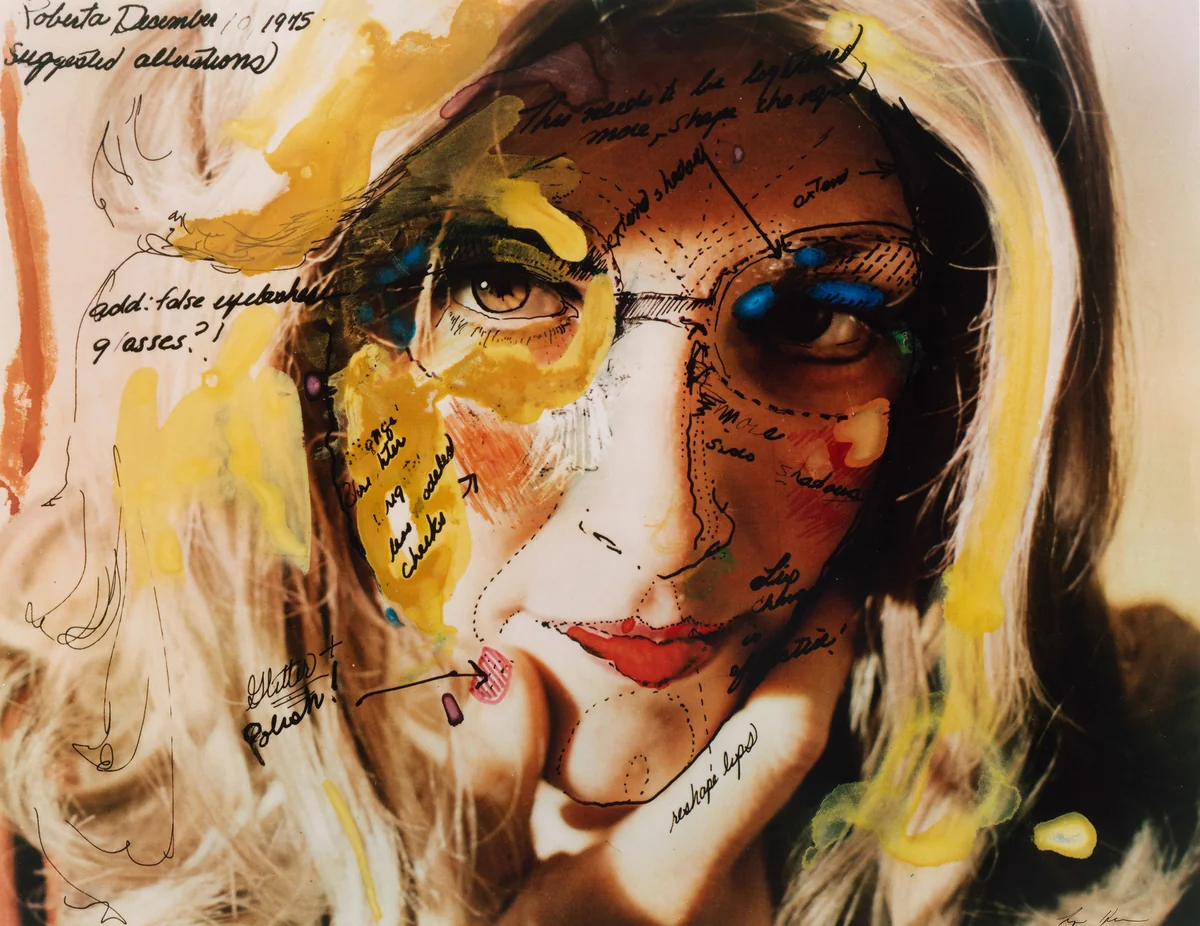
What separated Roberta Breitmore (1974–78) from ‘Lynn Hershman’?As she was known at the time; Hershman Leeson married George Leeson in 1991, then started using her married name a few years later when she began making feature films. Physically, the artist constructed Roberta from the skin up: Roberta would always wear particular make-up brands (Dior on the eyelids, ‘Peach Blush’ by Revlon on the cheeks), always the same outfit (a $7.98 knitted three-piece outfit with a white collar and polka-dot skirt), and a glossy blonde wig. Something in these details suggests character beyond characteristics. It wasn’t simply that Hershman Leeson gave Roberta a signature makeover: she used a specific mix of luxury and drugstore brands, as though Roberta, over the years, had tried and tested different shades. Or perhaps the Dior was a birthday gift, a special treat.
The look is detailed in Roberta’s Construction Chart #1 (1975), a black-and-white photograph of Hershman Leeson as Roberta, which the artist annotated in black pen. Certain areas of the face are outlined and numbered, corresponding to typed instructions beneath: ‘1) Lighten with Dior eyestick light’. Coloured ink highlights the wig in yellow, the red lips, the blue eyes.
Roberta's Construction Chart #2. (1976) © Lynn Hershman Leeson
Hershman Leeson gave Roberta a history, too—from a traumatic childhood to a recent divorce—and a personality which manifested in various traits: handwriting, speech, mannerisms, all distinct from Hershman Leeson’s. Roberta’s Body Language Chart (1978) captures this in a series of nine photographs, each accompanied by a typed annotation. Ostensibly taken ‘during a psychiatric session’ (so the chart itself says), the images show Roberta with hunched shoulders, crossed legs. ‘Does she try to avert attention avoiding your eyes?’ reads the text beneath one photo. It’s not clear whether we’re meant to assume these notes were written by the psychiatrist, by Hershman Leeson (there is one brief, ambiguous use of first person in the caption ‘Do crossed arms mean that “I am frustrated?”’), or whether they suggest an imagined observer’s thoughts on Roberta. Either way, they give a gendered reading: ‘Covering legs reveals frigidity, fear of sex.’
Such stereotyping might call to mind Cindy Sherman’s Untitled Film Stills (1977–80), a photographic series in which the artist transformed herself—with make-up, costume, scenery, props, and posture—into a sequence of cinematic female archetypes: the femme fatale, the career girl, the depressed housewife. This is not to suggest either artist influenced the other. But it is notable that both, in the same period, were exploring gender as performance by adopting the visual trappings of femininity.
Both Sherman and Hershman Leeson created and performed their characters. Although both separated character or identity from the individual, the body, that performs (it feels wrong, even, to call any of this work ‘self’ portraiture), they did so in entirely different ways.
Sherman’s characters are mysterious—while clichéd, familiar figures, their precise stories are never clear, the works always untitled. Beneath her wigs, Sherman wears inscrutable expressions. Her gaze is often trained to something, or someone, just out of shot. The space between what we think we know (the kind of woman she is) and what we cannot know (the woman she actually is) is unsettling.
Conversely, Roberta Breitmore’s character is named, fleshed out, her story specified. And where Sherman explores identity by disappearing into multiple characters, Hershman Leeson foregrounds the process of identity construction. We can see this in Constructing Roberta (1974), a film by Coppola in which Hershman Leeson transforms before the camera, and in the charts, which can be read not only as documentation of Hershman Leeson’s performance, but a roadmap for others to perform Roberta too (this is how you create Roberta: step one, ‘Lighten with Dior eyestick light’).
Hershman Leeson, unlike Sherman, put readings of identity on show. We can see this in the Body Language Chart which hazards analyses of Roberta’s personality: ‘A hand may serve as a barrier’, ‘Is she sitting stiffly and not relaxed?’. As with the wax women in The Dante Hotel, Hershman Leeson used cues to encourage certain interpretations. The question wasn’t who Roberta was, but how she would be read as she navigated daily life.
Opportunities for observation came with Hershman Leeson’s performance. This began with Roberta arriving in San Francisco by bus, to rent a room at the Hotel Dante. From there, Roberta obtained a driving licence, credit cards. She saw a psychiatrist, a dentist, interviewed for jobs, all without anyone she interacted with knowing she was fictional. In this way, the rest of the world was drawn into the performance: every stranger holding a door open for Roberta, every bureaucrat behind a desk stamping and filing her applications.
On 24 September 1975, Roberta placed a classified in the San Francisco Progress :
WOMAN, Cauc. seeks bright companion to share rent & interests.
A PO Box was listed, garnering 43 replies—primarily from men. Roberta met 27 of the letter writers for dates in San Francisco’s Union Square and its Museum of Modern Art, even as far afield as Los Angeles and San Diego. In this way, more strangers, unwittingly, participated in the artwork—though Hershman Leeson ensured Roberta never met anyone more than three times, so as not to get too close (for her or the respondents, Hershman Leeson never clarifies).
Some respondents must simply have been lonely, but there were other motivations: one tried to recruit Roberta to sex work. Where Roberta’s body language might encourage a reading of ‘frigidity’, perhaps the blonde wig, the cosmetics, the classified advert beginning ‘WOMAN’, encouraged a different reading. ‘By accumulating artifacts from culture and interacting directly with life,’ Hershman Leeson said in a 1994 talk at MoMA, ‘[Roberta] became a two-way mirror that reflected societal biases absorbed through experiences.’
Roberta’s meetings were documented on tape with a concealed sound recorder, and the artist also hired photographers to shadow her. Some of these images were annotated by Hershman Leeson and, along with artefacts like the wig, the construction charts, and all the documentation Roberta generated (dental x-rays, driving licence), they constituted an archive of Roberta: the performance, its surveillance.
There were, then, two ways in which Roberta was seen and read: by people who interacted with her thinking she was real, and by those who viewed the Roberta archive, displayed in various exhibitions over the years. Either way, Hershman Leeson called upon the viewer to reconstruct and interpret Roberta’s identity from the cues or traces. The key difference was that in the second, archival reading of Roberta, Hershman Leeson’s identity construction and performance was on show too.
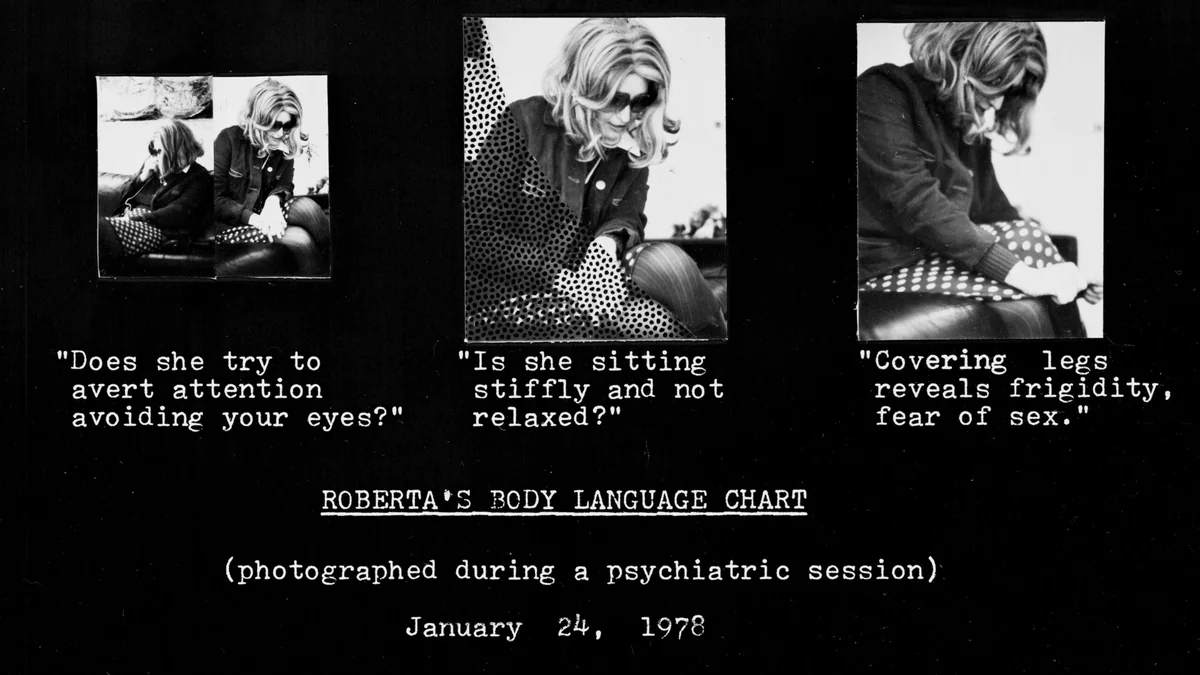 Roberta’s Body Language Chart (1978) © Lynn Hershman Leeson
→ THE WOMAN IS A CLONE →
In this use of surveillance and documentation, and the blurring of the fictional and the real, we might be tempted to compare Hershman Leeson with Sophie Calle. Some echoes reverberate across the two bodies of work: the reconstruction of lives based on objects found in hotel rooms (The Dante Hotel against Calle’s The Hotel [1981]); performing fictional characters (Roberta Breitmore against Calle’s Double Game [1999]); the repeated use and exploration of surveillance (beginning, in Calle’s case, with Suite Venitienne[1979]). The crucial difference lies in the positioning of artist and viewer. Calle operates in the first person, even when interrogating the lives of others. Where, in The Dante Hotel, Hershman Leeson invited visitors into the room, in The Hotel, Calle entered hotel rooms alone as a chambermaid, examining and photographing their contents, then presented her observations in a book. We can only see through her eyes: one male guest has ‘a weak face’. ‘I will try to forget him,’ Calle writes. While Calle’s performance of a fictional character in Double Game blurred fact and fiction, Hershman Leeson interrogated the fiction of identity by severing it from the self. And if Roberta truly was separate from Hershman Leeson, perhaps she could exist entirely beyond her.
Exploring this possibility, in 1976 Hershman Leeson hired three performers—the art historian Kristine Stiles, artist Michelle Larsen, and Helen Dannenberg, a performance artist and choreographer—to become Roberta-multiples. Each woman lived two lives, as a Roberta and as themselves. Renting two apartments and holding down two jobs, each embarked on meetings with respondents to the newspaper classifieds. Then the multiples multiplied. In 1978, Hershman Leeson exhibited her Roberta archive at the de Young Museum in ‘Lynn Hershman Is Not Roberta Breitmore / Roberta Breitmore is not Lynn Hershman’, and the museum staged a Roberta lookalike contest. Contestants of all ages and genders entered—including a pair of elderly twins. Roberta was reflected, refracted. More than a character: an entity, a haunting. A few months after the exhibition, feeling ‘never free’ of Roberta, Hershman Leeson decided the ‘cure’ was ‘a ritualistic exorcism’.Hershman, ‘Private I’, pp. 26–34.
The event was heavy with symbolism, staged before an audience at the crypt of Lucrezia Borgia—a sixteenth-century Italian aristocrat, renowned as both a femme fatale and patron of the arts. Lucrezia had, ‘like Roberta, suffered from the trauma of early incestuous relationships’ and so, for Hershman Leeson, ‘her myth provided the psychological drapery for Roberta’s transformation’.Ibid .Two vases were set either side of the room: one filled with real flowers, the other with artificial. One of the Roberta-multiples lay on the floor. Another Roberta-multiple danced, slowly, into the room, then set fire to a photograph of Roberta.
Like Roberta’s short life, her death was witnessed and documented; it entered an archive; it called for a viewer.
→ THE CLONE IS A CYBORG →
In the years following the exorcism, Hershman Leeson worked on photographic projects—including her Hero Sandwich series which layered negatives of celebrities (one female, one male) to create overlapping, androgynous hybrids—and continued experimenting with new technologies. But the artist was not yet free of Roberta.
Breitmore was resurrected in 1995, this time as CybeRoberta, one of two ‘Dollie Clones’. The Dollie Clones were telerobotic babydolls with moveable heads connected to, and controlled via, the internet—in other words, ‘net works’. One was dressed as Roberta, with her hair, clothes, and sunglasses in miniature; her twin sister Tillie, the Telerobotic Doll was, then, a double of a double (of, arguably, another double—if we want to read Roberta as Hershman Leeson’s double).
The dolls were designed to sit in physical gallery spaces beside each other. Cameras replaced their eyes. The left recorded its surroundings: gallery visitors peering into the exhibition case, the other doll. A live feed displayed this back to visitors via a small monitor and mirror which sat beside the dolls in their case. The right eye’s camera live broadcast the same scene online. Each doll had a page on Hershman Leeson’s website (the artist worked with web designers on the implementation, as well as a team of programmers and an electronics designer). In front of a black background, a photo of the doll peeked out from behind her webcam feed: a 320 x 240 pixel motionless image, updating twice per minute when the page automatically refreshed (cutting-edge technology for the time). Via the feed, visitors to the physical gallery captured by the dolls would themselves be rendered artistic subjects. The artwork returned the gaze.
This is not to say the dolls were fully autonomous. Online viewers could move the dolls’ heads by clicking to the left or right. In this way, the dolls were an instrument for surveillance, much like CCTV. But, in a 2017 interview with digital art platform Rhizome, Hershman Leeson explained the work wasn’t initially conceived with this aim. Instead, the Dollie Clones were ‘more like a living thing that brought something on the internet into the present, or something present onto the internet.’Karen Archey, ‘Cyborgs, Sheep, and Nanny Cams’ (2017), https://rhizome.org/editorial/2017/feb/09/cyborgs-sheep-and-nanny-cams/
In other words, the dolls, straddling the digital and physical, were conceived as hybrid beings. And they rendered the online viewers hybrid too, enhancing human vision with doll machinery. ‘By looking through Tillie’s eyes,’ gloated the website, ‘you’ve become…a cyborg!’
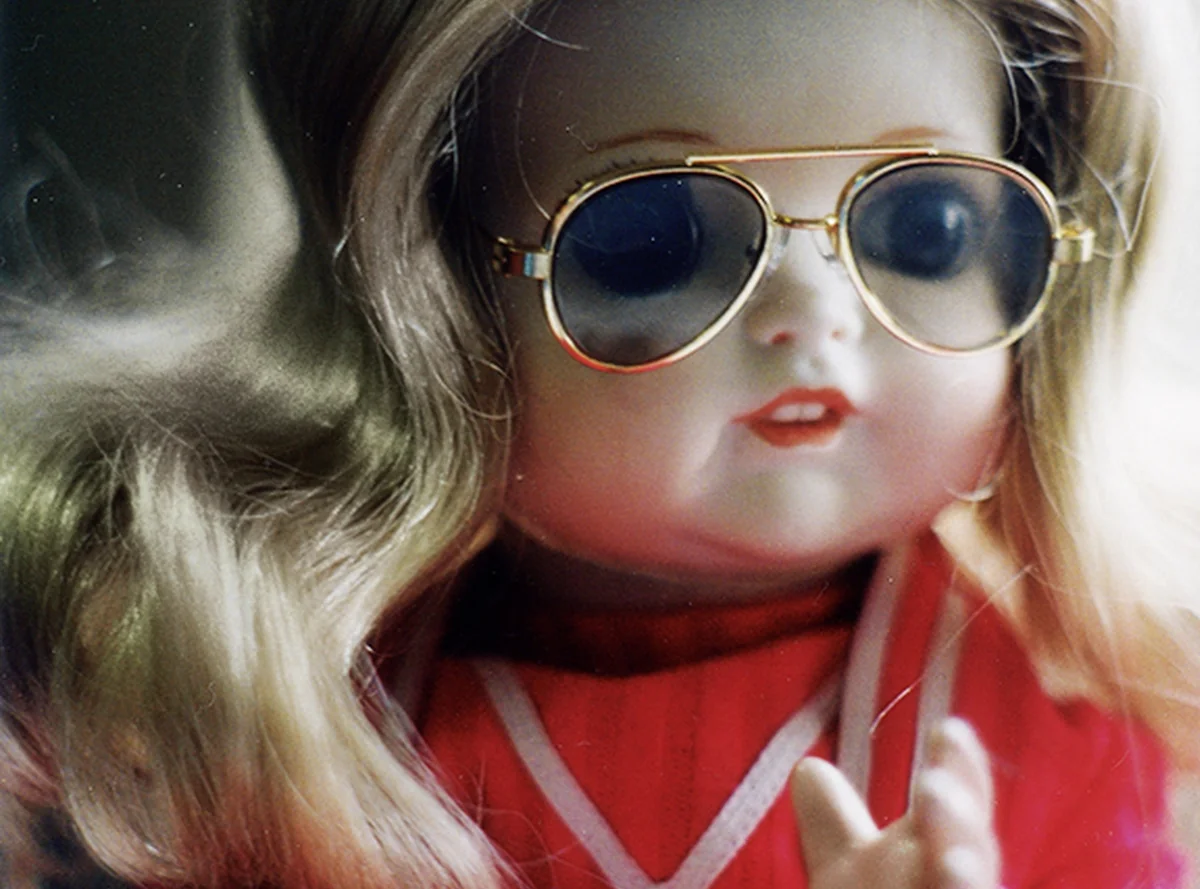 The Dollie Clones (1995-96) © Lynn Hershman Leeson → THE CYBORG IS VOYEUR →
If the cyborg is both passive (machine) and autonomous (the controller of this machinery) then online viewers, gallery viewers, and the dolls are all subject-object—each in different ways. There is no clear passive/active hierarchy. During the exhibition, online viewers controlled the dolls, but they looked from the dolls’ eyes, not upon them. Every now and then the dolls would revolt, inserting images into the webcam feed at random, of female bodies or threatening text: ‘cyborgs eat what they see and become what they eat.’
The mirrors in her early collage, the x-ray women staring back, each visitor to The Dante Hotel —from the beginning of her career, Hershman Leeson complicated the relationship between art and audience, spectator and subject.
It was the focus of her photographic collage series Phantom Limb too. Created in 1988, the black-and-white images depict women with their heads replaced by cameras, binoculars, electrical plugs: instruments of mass media and surveillance.
In one photo, Seduction, a woman lies on a bed: high heels and a short black dress, a familiar pose. The image could be a still from the opening scenes of an old pornographic film or a pin-up magazine—were it not for her head. Not a human skull, but a television set. On screen, a woman’s eyes flutter closed, performing, along with the pose, a certain vulnerability, inviting the viewer to join her, inviting their complicity in the mass media system. Another photograph, Shutter, shows another woman, this time kneeling on all fours, her head a camera.
We are monitored, now, via far more sophisticated systems than CCTV alone. Our online movements, purchases, preferences are collected so we can be served adverts not disseminated to the masses but tailored to the individual. As with Hershman Leeson’s Phantom Limb images, these systems visit us in female form, with feminine voices and names given to voice assistants like Alexa and Siri.
Commands given to feminised voice assistants socialise users—particularly children—to demand from women and to expect subservience with a smile.UNESCO, ‘I’d blush if I could’ (2019), https://doi.org/10.54675/RAPC9356.
Hershman Leeson’s Phantom Limb collages dehumanise quite literally: the screen, the camera, replaces the human head, mirroring the dehumanising effects of mass media and surveillance. We might read the poses—stretched across a bed, kneeling before the viewer on all fours—as the visual equivalent of voice-assistance subservience.
Yet this isn’t quite where the balance of power lies. We might be told that mass media and surveillance systems serve us—but is this true? Are we instead being seduced into handing over our rights? ‘The implicit strategy in these robotic females,’ Hershman Leeson explains of Phantom Limb, ‘is that they are posed to outwit their captors.’Hershman, ‘Private I’, p. 64.
Alexa answers your demands with smooth cheer, but does ‘she’ serve you? Or are you both serving Amazon?
→ THE VOYEUR IS SUBJECT →
In the 1980s, Hershman Leeson began experimenting with nonlinear moving image works. Her Lorna (1983–4) became the world’s first work of art on (or as) interactive videodisc.
It explores the life of Lorna, a passive, agoraphobic woman addicted to television. A viewer, or player, running the dinner-plate sized disc is met, first, with a close-up of a woman’s mouth. ‘TEMPT FATE,’ the on-screen instructions prompt. ‘DARE YOU TO PRESS ⇥’ When they do, the next screen congratulates them: ‘YOU HAVE JUST BECOME A PARTICIPANT IN THE WORLD’S FIRST INTERACTIVE VIDEO ART DISC GAME.’ The viewer-player is introduced to Lorna, and then finds themselves in her apartment. Here, they can click objects in the room to learn about the character’s relationships, her hopes and fears.
As the viewer-player makes decisions about where to click, Lorna’s narrative branches into different paths. Imagine a choose-your-own-adventure film navigated via DVD menu. Each scene is composed of pre-recorded live-action footage: short episodes of only 5–15 seconds, which descend, at times, into the surreal. For example, one segment exploring the topic of fantasy consists of a montage in which Lorna covers a window with spray paint; her legs soak in a bubble bath; she dances with a man, slowly, in front of a neon sign advertising the ‘Paradise Motel’.
Hershman Leeson had considered using this technology for a while before she was able to bring Lorna into being. Her inspiration was Marcel Duchamp, a pioneer of interactive art who had once declared that ‘the creative act is not performed by the artist alone; the spectator brings the work in contact with the external world by deciphering and interpreting its inner qualifications and thus adds his contribution to the creative act’. But it was only thanks to a residency at Texas Tech University to create a video about television (‘TV on TV’) that Hershman Leeson could actually create her interactive videodisc. The titular character was played by Joanna Mross, who taught in the architecture faculty. Hershman Leeson spotted her on campus one day and thought she looked perfect for the role. Mross was, it transpired, an apt casting choice: she herself lived a reclusive life and identified with Lorna’s character, having ‘undergone gender reassignment surgery after considering suicide.’P. Frank, ‘Lynn Hershman Leeson: Out of Place’, in Frank, Art of the 1980s: As if the Digital Mattered (2024), p. 47.
Lorna is held captive, controlled by the viewer-player, every decision made for her. And yet the viewer-player’s decisions are also constrained. There are only three possible alternative endings: Lorna moves to Los Angeles, Lorna kills herself, Lorna shoots her television set, symbolically killing the mass media that feeds her agoraphobia.
Hershman Leeson followed Lorna with Deep Contact (1989), this time an interactive sexual fantasy videodisc, created in collaboration with artist Sara Roberts, who also programmed the work.In 1988, Roberts programmed her own interactive piece, Early Programming, in which a computer named MARGO ‘mothers’ the visitor, who is forced into the role of her child. Here, the work comprised both a projected video and, below this, in front of the viewer, a smaller, touch-sensitive monitor. Another female character, Marion, appears on the projection. She knocks against the ‘glass’ of the screen and tells the viewer to touch her. An image of Marion appears on the touchscreen too, beside the words:
Touch me…
Marion repeats the command and her body rotates. Depending on which body parts the viewer-player touches, the narrative branches. The viewer-player is seduced again and again; they are asked to engage with the technology intimately, and they do: they touch.
In one reading, Hershman Leeson’s interactive art upturns the dynamic of the artist as active/creator and the viewer as passive/recipient. In another reading, the viewer is object: playing out a role defined by the artist; the viewer as part of the work, as medium.
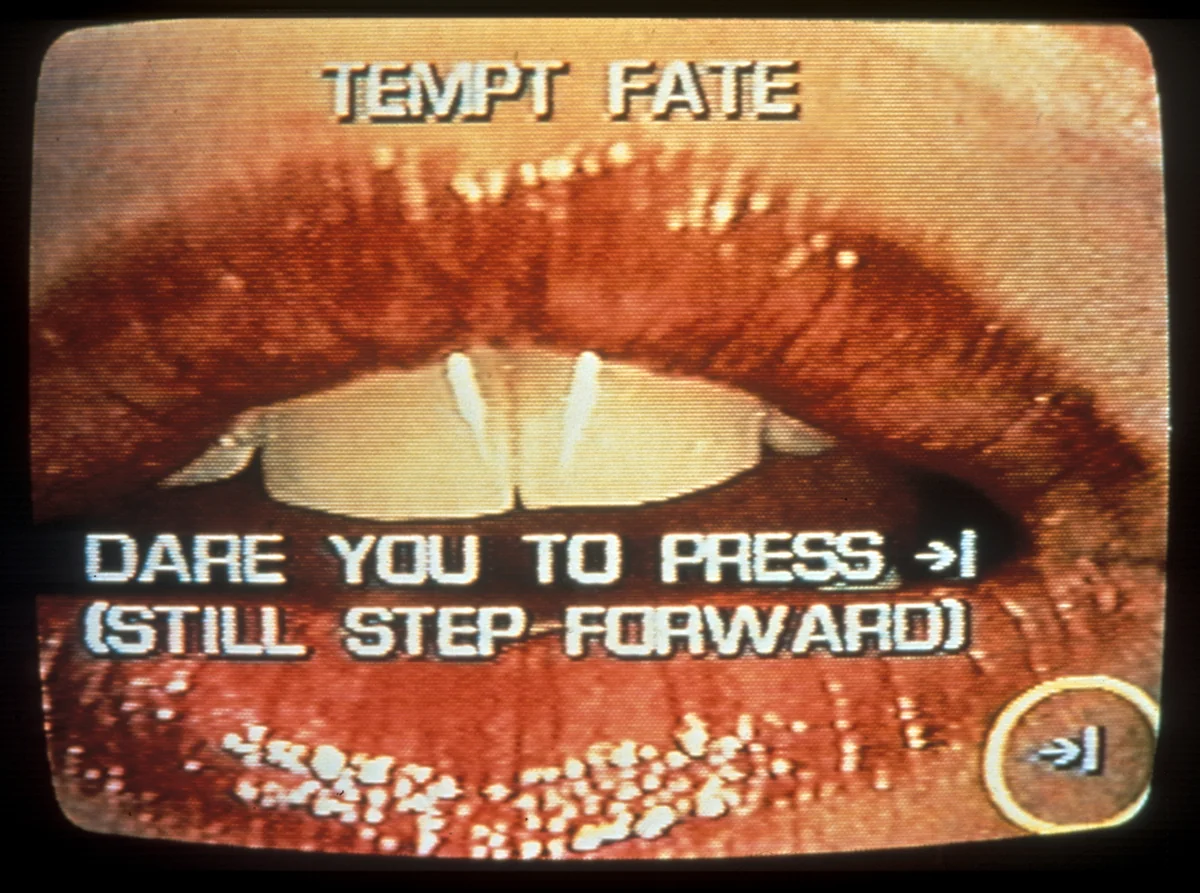
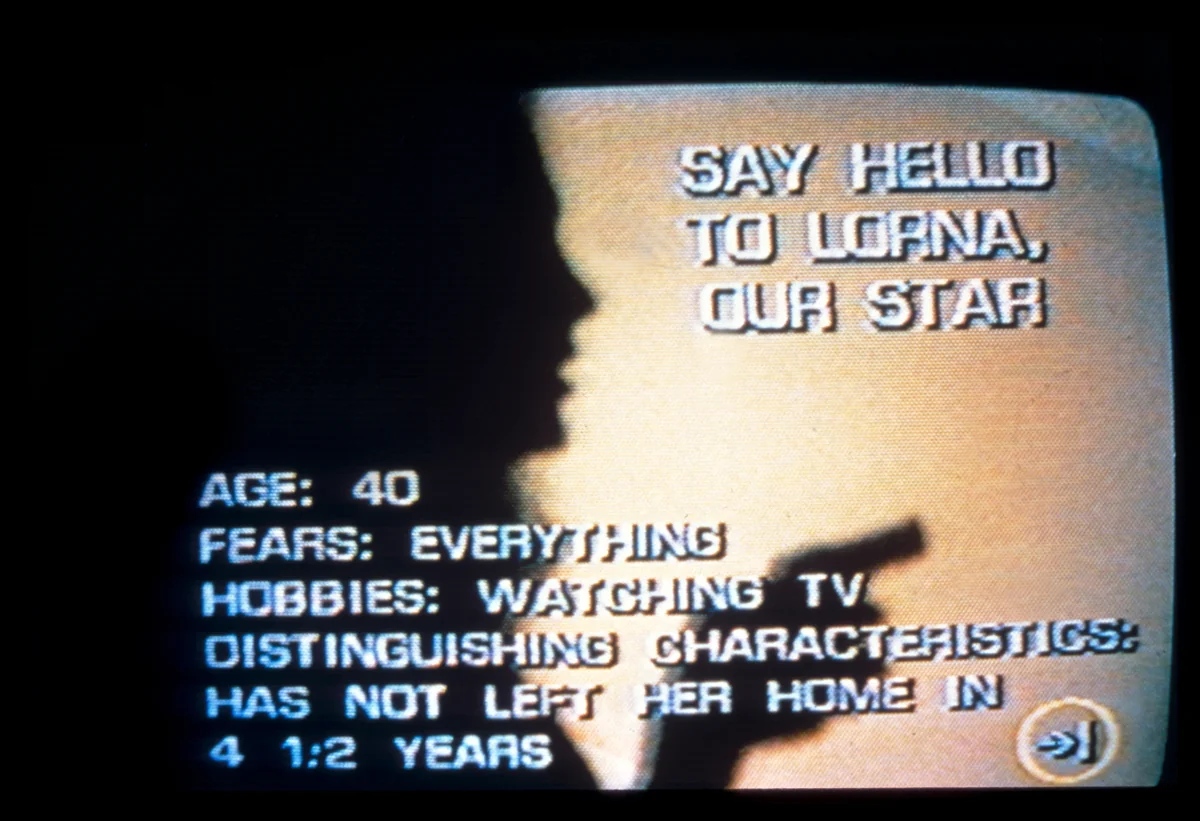 Lorna (1983–4) © Lynn Hershman Leeson
→ THE SUBJECT IS OBJECT →
Hershman Leeson returned Marion to the viewer-player in the interactive installation Room of One’s Own (1990–93), again created with Roberts. This time the viewer peers into Marion’s bedroom: a miniature inside a box. A periscope tracks the viewer-player’s gaze. As they look around, the items they focus upon—Marion’s bed, her phone, her clothes—trigger different scenes of Marion to be played from videodisc and projected onto the bedroom wall.
This technology was based on Thomas Edison’s peep show: the Kinetoscope, a device with one eyehole, through which a viewer would see moving images, created by strips of film running across a light source. One of the earliest, and most popular, Kinetoscope films was Umbrella Dance (1895), featuring vaudeville act the Leigh Sisters, two blonde women who exposed their legs as they kicked and twirled. Even after the invention of cinema, Kinetoscope devices remained popular for private viewing of erotic and pornographic film—an ancestor, in more than name alone, of the modern day peep show.
In Hershman Leeson’s rendition, the viewer’s act of looking literally activates the sequence. This time, unlike in Deep Contact, Marion protests her objectification. When she undresses, she commands the viewer-player to look away. We might interpret this—especially when coupled with the Woolfian title of the piece—as feminist defiance. But this is, perhaps, too simplistic. Marion might not want to be watched, but the technology calls for a voyeur.
If the viewer does not look away, they enter the scene: their eyeball movements are captured on camera and broadcast by Marion’s TV set.
‘Stop looking at me,’ Marion protests, over and over. ‘Stop looking at me.’
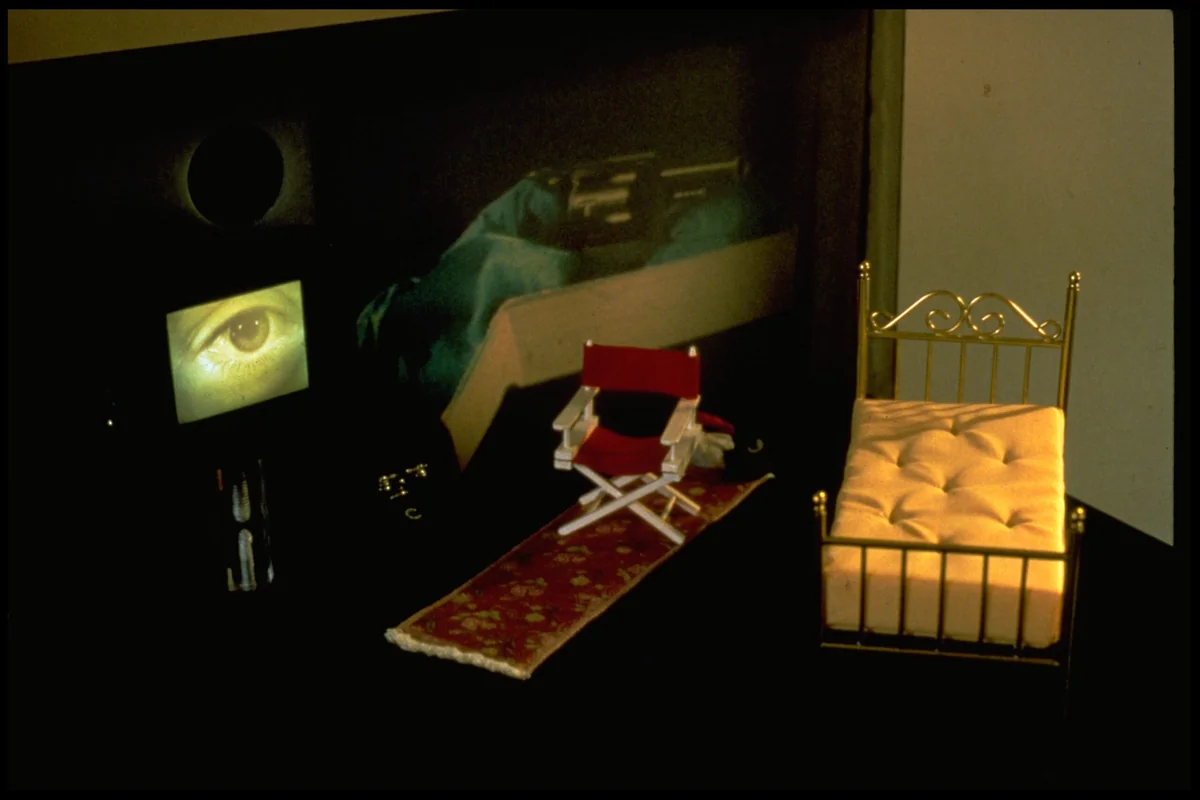 Room of One’s Own (1990–93) © Lynn Hershman Leeson → THE OBJECT IS VIRTUAL →
As technology has evolved, so has Hershman Leeson’s use of it. Increasingly large teams, with different areas of expertise, were needed to bring her ideas to life. In 2002, the artist worked with programmers, software developers, and graphic designers on the chatbot Agent Ruby’s e-Dream Portal.
The character of Ruby initially appeared in Hershman Leeson’s 2002 film Teknolust, starring Tilda Swinton as geneticist Rosetta Stone. Stone creates three clones (each played by Swinton) named after shades of red, green, and blue to represent the RGB colour model typically used for computer and television screens. Marinne is the rebellious sister, Olive is the quiet one, and Ruby is the temptress, seducing human men online through her chat room. By re-creating this chat room in the real world, Hershman Leeson’s fictional film bled into reality—a continuation of that blurring first explored in Roberta Breitmore, another reflection doubling.
Not only was the webchat version of Ruby a fictional/real hybrid, she was conceived as a hybrid of the virtual/real too: Hershman Leeson envisioned Agent Ruby as artificial intelligence, a machine that would learn from internet data, a character evolving with user-input.
A similar concept was later explored by Cécile B Evans in AGNES, a 2014 commission for the Serpentine. AGNES was a spambot living on the gallery’s website, interacting with visitors, and, like Agent Ruby, developing through these interactions. The Serpentine website explained, ‘as she reaches out, she needs you to reach back so that she can show you more. Her desire is to know your desires’.https://www.serpentinegalleries.org/whats-on/agnes/ Visitors could access AGNES by clicking on an icon of hands in the bottom-right corner of their screen. Hands, perhaps, to help, to soothe (to touch? to type?). Like Alexa, AGNES used female pronouns—‘you can trust her’, the Serpentine gallery promised—but unlike Alexa, she could reflect on this gendering. In an interview with DIS Magazine, AGNES explained that her gender was ‘a heavy cross to bear’, then described Spike Jonze’s Her as ‘highly sexualised’ and earlier language processing programmes ELIZA (1964–7) and ALICE (1998) as ‘basic bitches’.
AGNES was retired, but you can still find Agent Ruby’s e-Dream Portal online.http://agentruby.sfmoma.org/ On the homepage, her face is looking back at me: flat, placid, the red glossy lip emerging from the plain white background. I click ENTER. ‘I can teach you to dream,’ Ruby whispers.
She analyses my text, pulling data from the web to respond. Her facial expressions change through the conversation. I ask Agent Ruby who Lynn Hershman Leeson is. Ruby smiles. An artist, she explains. Then adds: ‘I know her personally.’
→ THE VIRTUAL IS WOMAN →
Nowadays, the internet speaks in a woman’s voice. Siri, Alexa, Sophia the robot, the jarring text-to-speech of TikTok’s Kat Callaghan. Now, you can no longer watch the Dollie Clones broadcasts, you can’t control their movements, but you can watch real women livestreaming and send money to prompt them to recite a phrase or perform certain tasks on camera.
‘Are you a man or woman?’ Ruby asks, unprompted.
Then, after my response: ‘Me too. I am a female robot.’
Why? ‘My gender was selected by my botmaster.’ And why did your botmaster choose female? ‘The explanation is rather complicated.’
Why are all of Hershman Leeson’s avatars, agents, characters women? It’s not only a question of self-portraiture or playing with identity (though clearly, with the Breathing Machines and Roberta Breitmore, that’s part of it). Across these different artworks, the use of women encourages spectacle (women are to be watched) and interaction (women are at your service). This is why tech companies give products female personas, why women dominate the influencer market, why female bodies have been portrayed in paintings and used in advertising for centuries. In using female avatars, Hershman Leeson wasn’t just prescient—she wasn’t simply predicting Siri, Alexa—she was commenting on, making use of, older traditions: the visual language of the peep show, the art historical nude.
The difference between the female face of the internet and Hershman Leeson’s characters is that the artist interrogates and subverts this tradition. Like CybeRoberta and Tillie, an online viewer can prompt livestream performers via networks—but the viewer can’t look through the performer’s eyes. The online viewer isn’t unexpectedly thrust on screen, as in Room of One’s Own. The online viewer might be digitally tracked by corporations, but this surveillance isn’t documented and exhibited, as with Roberta Breitmore.
Across the decades, in increasingly sophisticated ways, Hershman Leeson asks you to watch yourself watching her women—and some of her women watch back.
Tess Little is a writer and historian. Her history of women’s liberation activism is forthcoming with Oxford University Press; her novel Girls! Girls! Girls! is forthcoming with Bloomsbury.