
The Mess of Making: A Conversation with Onyeka Igwe
The adaptation sets out to make correspondences clear… The function of the theatre is to explode fears by bringing them out into the light of day…
– Sylvia Wynter
Onyeka Igwe’s A Radical Duet (2023) brings the creative process sharply into focus. Halfway through the film, which hovers between self-reflexive documentary and speculative historical fiction, a circular pan illuminates a rehearsal space. A series of syncopated shots reveals this room to be a bustling site of experimentation: actors play with lines, perform various warm-ups and deep breathing exercises. Serious work is about to unfold. Amid all this productivity, the camera foregrounds a large table littered with stuff, momentarily pushing the actors to the periphery of the frame. A black speaker, white paper cups, fragments of newspaper clippings and diary entries with undecipherable scribbles. A rich assortment of books spotlighting canonical works of anticolonial thought. Paper (so much paper). And photographs of the faces and places that shaped radical Black political life in mid-20th century London. Together, this material clutter constitutes a raw portrait of what we normally don’t see onscreen: the mess of making.
Onyeka Igwe is the curator of these materials on the table: snippets, she divulges in the film, of the research she has been ‘gathering, amassing over time’. As she enters the scene as director, the actors assemble around the table to learn about their convener’s process. As Igwe passes around fragments of journal entries and photographs, history is reanimated in the present. The cast onscreen functions as a multigenerational chorus of voices who effectively annotate Igwe’s research with personal anecdotes about the source material being circulated around the table. Legendary thinkers including Sylvia Wynter, C.L.R. James, Kwame Nkrumah, and Funmilayo Ransome-Kuti are conjured through the engaged discussion, charging the rehearsal room with an echoing of revolutionary Afro-diasporic voices through time.
Igwe is a multidisciplinary artist working across video and installation, often experimenting with sound, image, and text as discursive tools to unsettle hegemonic narratives of colonial archives and to centre marginalised histories. Her expansive research practice often makes its way into her film frame, which can feel like a gift to viewers, allowing us to probe the materiality of the archive while problematising questions of authorship and ownership. In A Radical Duet, the artist’s process is framed as a work-in-progress, a conversation. What we are witnessing is collaboration.
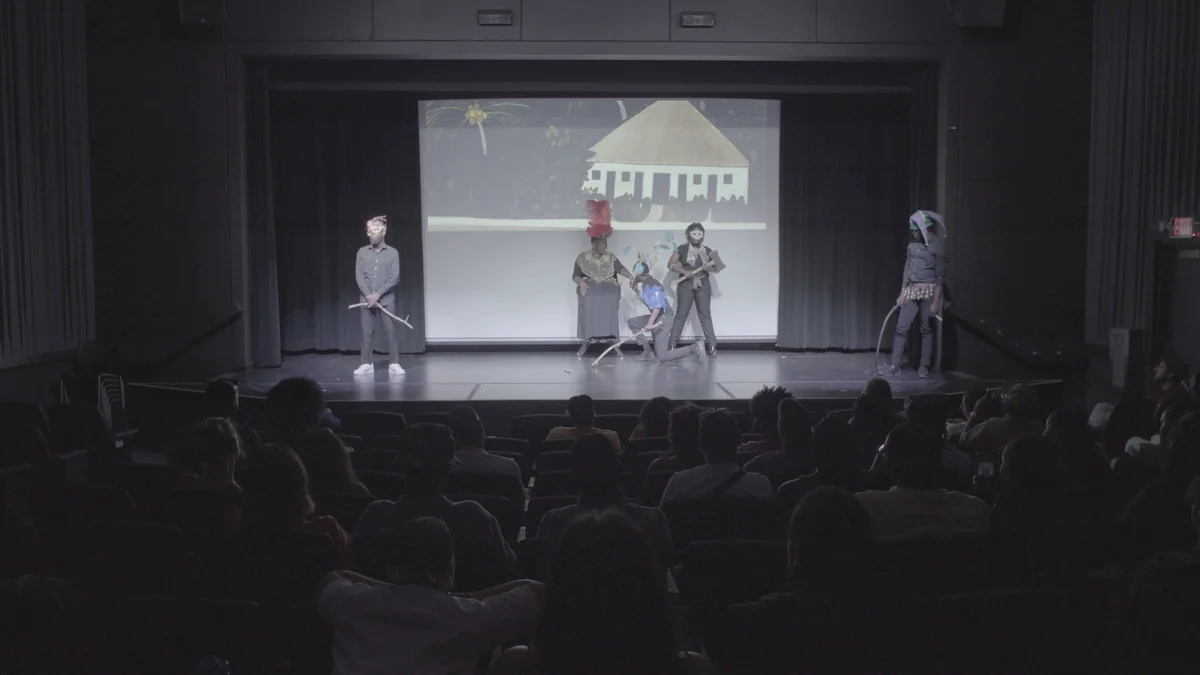
I encountered Igwe in a similar context. In a black-box studio in East London, I attended an ‘interactive performance workshop’ hosted by the artist as part of Open City Documentary Festival. Inspired by ‘the political plays of anti-colonial thinkers’, the programming text promised ‘dramaturgical games, live readings and prop making in order to understand the ways in which radical theatre can be a tool for exploding reality.’ In a circle of about twenty participants, a diverse group of festival-goers, filmmakers, programmers, students, I anxiously awaited Igwe’s instructions. Igwe started the workshop with an introduction to C.L.R. James’s play Toussaint Louverture: The Story of the Only Successful Slave Revolt in History, a precursor to his seminal text, The Black Jacobins (one of the many sources that appears on the table in A Radical Duet). As Igwe passed around pages of the play’s opening scenes, she warned that the text was challenging. The play centres Toussaint Louverture, Black revolutionary and architect of the Haitian Revolution, reimagining the history of slave rebellion and collective uprising against oppressive forces. The 1936 stage production represented a watershed moment in British theatre history; both playwright and cast, featuring Paul Robeson, were Black. Our amateur cast was energised and eager to begin; when Igwe asked for volunteers to read the first scene, hands shot up in the air. The directive of our gathering: to ‘rearrange society’ through performance and play.
The difficulties of our assignment soon surfaced in an affecting moment when one participant refused to read a word in the script. Her refusal to speak the text as it was printed became its own moment; a silent act prompted a palpable shift in our circle. As we sat in loaded silence, I had an impulse to question. Why was this woman offended? Why was I not? Do any of us have the right to be? Surely, the parameters of our play were mediated by a trust in text and facilitator: an understanding that this language had been used by the playwright for a purpose. I struggled with the idea that one person in the circle could control the outcome of the performance for the group. By the time I was ready to compose my thoughts and raise my hand to share them, another participant in the scene read their line. We moved on. A few beats later, the word appeared again on the page and we again witnessed our castmate’s muted refusal. I could have shared a half-formed thought or fragment of lived experience to engage her in conversation, but I joined the others in staying quiet. Perhaps, in that moment, I was a bad collaborator.
After the table read of the play, the workshop concluded with a challenge from Igwe: to create different props from the scenes. We splintered off into small groups and started cutting up recycled pieces of cardboard. As I played with the weathered material, I thought about the elasticity of a term like ‘adaptation’. Thinking beyond an altered or amended text, I lingered on what it means to adjust to new environments and individuals. I scanned our rehearsal room, with its fragments of cardboard and conversation scattered about the dimmed rehearsal space: proof that the charge of ‘rearranging society’ or experimenting with others is always messy.
As the festival’s spotlighted filmmaker, ten years of Igwe’s work was programmed across three sections. Curated around the themes of landscape and performance – key sources of inspiration shaping the artist’s visual tradition – the festival showcased celebrated works alongside newer pieces. Igwe collaborated with the festival team to curate the programme: a unique opportunity, she said, to imagine her films in a new context for a different audience. In the line-up, she included a selection of artist films and videos that had been made for British television when she was growing up – which, she realised latterly, may have contributed to her visual style.
And whether accidental or meticulously mined through research, this palimpsestic visual style captures a constellation of temporal crosscurrents. Igwe reflected on her practice that, ‘I would like to hold the past, present and future in the singular space of the frame and allow multiplicities of sound, movement and images to point towards these unbounded temporalities.’
I sat down with Igwe during Open City to talk about her process of archiving against the grain, the charged silences that accompany collaboration, and what it meant to be the filmmaker in focus at this year’s festival.
Amari Rose Leigh: I’ve been thinking about the evolution from text on the page to performance a lot since I participated in your workshop. Obviously, the language in the scene you had us read from Toussaint Louverture: The Story of the Only Successful Slave Revolt in History is pretty racially charged. I think you used the word ‘grotesque’ during the performance workshop. There were two moments in particular when a white participant didn’t want to say the word ‘Negro’. And you could tell from her face that she was really put off by the language. It altered and impacted the performance. I understand why she didn’t say it, but at the same time, the word itself is neither offensive nor pejorative, just a historical labelling of Blackness. So, I am curious about these moments of tension. What did you make of that moment? Was it something you expected or anticipated?
Onyeka Igwe: Yeah, I did notice that. And I thought, I wonder what she thinks this word is. Do people not say the word ‘Negro’? I haven’t ever received the word as an insult. This is the way people used to refer to Black people. But I could see that she was confused about it and didn’t want to say the word. And then, no one talked about it, but the space felt charged in some way. And then I also noticed that two Black people left the workshop. It was after we did the first scene and I was like, oh, that’s such a shame, they didn’t get to see the second scene. Because the scenes go together and, as people observed, there’s this kind of dialectical relationship between them, but I don’t know... I presumed that maybe they were just not interested in taking part in a workshop where people are using, as you say, racially charged language.
So, I noticed those things and I did think about it being a difficult text to engage with, and I didn’t know who was going to turn up. I had thought about the racially charged language before and I wanted to bring it up in some way. I think I could have held the space a little bit better and actually talked about the participant’s reaction to encountering this language rather than just letting it kind of just fall. It’s not something I’d noticed when reading it by myself. Because I knew people were going to read it aloud, I suddenly started thinking about the language in a way that I wouldn’t have otherwise.
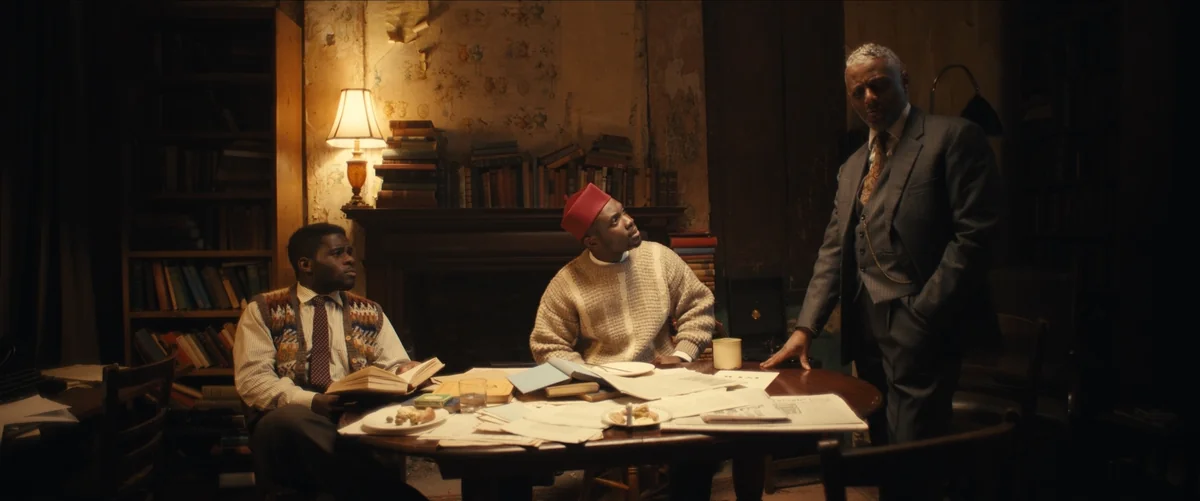
AL: I think a big takeaway from the workshop is that collaboration is messy and play can be messy. And that’s part of the experiment of rearranging society, as the title of the session suggests. It reminded me a lot of A Radical Duet and that moment when you show a development workshop with your cast. I love that scene because I think it’s just so generous to the viewer. And I was curious – how do you view collaboration? I love the shot panning over the clutter of material on the table…
OI: Clutter is definitely part of my process. The workshop format speaks to me because I’m interested in collaboration. I cannot imagine what other people are thinking, what their references are, what they might bring. So, collaborations are always additive. They always help me to expand, to learn more, to push a bit further, to provide depth. [Laughs] I guess it’s kind of selfish. I get to learn at the same time. There’s a limit to what I can produce and what I can think. With the A Radical Duet scene, that wasn’t even half of the material I was engaging with, but I was just trying to give them a little bit. But also, they bring things to me that then get incorporated in. So, it’s reciprocal. I want it to be, ideally. I’m not going to pretend that collaboration is always, can always be that, but the ideal is that it’s a reciprocal kind of exchange rather than just me directed outwards or just me receiving.
AL: I’ve seen this idea of shared authorship in writing about your work. I was thinking about that in relation to collaboration; how, in many ways, you are collaborating with theorists…
OI: In many ways, A Radical Duet is some kind of attempt at a collaboration with the theories of Sylvia Wynter. Like, can I put these theories, the power of narrative, into the voices of some characters and get them to play it out and see what comes? You know, I come to the work with questions. And I also want the audience to have questions, so there is a kind of folding in or collaboration between both the source and also the audience. Like, we’re all working together to kind of figure something out.
AL: Do you mind sharing what some of those questions are? Why has Wynter proven to be such a capacious source for you?
OI: Because, I mean, her theory is capacious, right? For me, she’s got such a convincing genealogy of how the human comes to be over-represented by this version of Man.Critical theorist Sylvia Wynter worked to decouple definitions of the Human from the figure of Man through her layered philosophical project. Igwe, who has studied Wynter extensively, recommends Wynter’s 2006 article, ‘On How We Mistook the Map for the Territory, and Reimprisoned Ourselves in Our Unbearable Wrongness of Being, of Desêtre: Black Studies Toward the Human Project’ as a text for readers interested in learning more. And of how, to change our social reality, we basically need to tell another story. I think I’m always attracted to how we change our social reality. But I’m just like, how can I tell a story that can change our social reality? I can’t. Like, no film that I make can do that. So, I want to know what else is needed. I don’t want to abandon the possibility of such a wonderful kind of proposition. I’m just like, let’s pull a bit more and see what else could make this argument real.
AL: What role does research play in your process?
OI: It’s very central to my filmmaking and to my practice. I think maybe it’s just my background. I come from the humanities. My first impulse if I have a question, if I’m curious about something, is to apply the kind of skill set that comes from a background in research to that question.
I’ve tried to start thinking about research a bit more expansively. It doesn’t have to be like reading a book, engaging with the theory; it can also be about being in the world, talking to other people, smelling things, eating things, dancing. I’ve started to think about all these things as research. How do I learn? Honestly, that’s the question. And the way that I learn is very multifaceted and it starts from subjectivity, from my experience. My mum has always been the source of knowledge. If I have a question about things pertaining to Nigeria and culture, I’ll ask my mum, you know? From the first things I made, I was never shy about my mum being as valid a source as any book or theory that I might read.
One of the strongest things that I argue through my work is that there is no capital-T truth, that there are multiple truths. I reject this kind of hierarchy of knowledge, that books are at the top and the anecdote that you hear from your mama, your friend or your family member is at the bottom. They all contribute to the making of a picture – not an image, but you know, a picture of something.
AL: Something I really admire about your work is that I feel like it always has this tone of futurity: you’re looking towards the future and how society might be rearranged. But then it also feels so grounded in a research practice that draws from the past or works in service of a lineage of people like Wynter and James. Your work pushes me to think beyond the binary of future and past, or present and past… I was curious about whether you think about temporal distinctions.
OI: I’m very glad to hear that the binaries of past and present are troubled in some way because that’s what I’m invested in personally. I am very much engaged with history, but with what it can offer us in the present. I’ve always wanted to think about time outside of a linear kind of progression. The past, the present and the future are all happening at the same time. And, because that is the case, time is like a series of places that we can kind of visit, basically. And I want my films in some way… for that kind of temporality to be manifested within the film.
AL: I was just thinking about a moment I really love in A Radical Duet: seeing the papers and the notes on the table next to the Carnation condensed milk can. As a Caribbean from Brooklyn, I recognised it as something that was in my fridge growing up, you know? So each viewer brings a distinct perspective that enables varying levels of ‘unpacking’ the visual, textual, temporal layering at play in your work, but there is also a limit. I think it’s nice to be challenged by this kind of opaque visuality, but do you ever have concerns over legibility? Or, like living with the discomfort of illegibility?
OI: Definitely. Legibility and illegibility are a constant push and pull whenever I’m making something. Thinking about the colonial archive, how do I direct people away from the kind of colonial racist intentions behind the material and at the same time leave enough space for them to have their own take on it?And that has proved to be quite a difficult thing for me to do because I had screenings and people have just said all this stuff about what they’re seeing. And I’m just like, okay, it’s not moving far enough. And what they think I’m doing is also not my intention. And so this thing of whether I need to be more direct is like a bird on my shoulder constantly tweeting at me when I’m making things. And, I think, maybe the balance was never something to be resolved. But it’s always a question that propels the making in some way.
Learning about Édouard Glissant and opacity was obviously like, oh, yeah, this is exactly how I think of a conditional experience of Blackness that is somehow wrestling with opacity and transparency. Like, where on the continuum do I want to be? And I also realised that to some people you’re going to be opaque and to others transparent, you know?
But then sometimes things feel so charged that opacity feels like a cop out or like not taking responsibility in some way. And sometimes I’ve felt the same way with these colonial images. It’s like, do I not need to be a little bit more direct about something that has been understood in such a way, for such a long time? Sometimes I have the understanding that one kind of conception of something is so powerful that being a little bit opaque is maybe not sufficient.
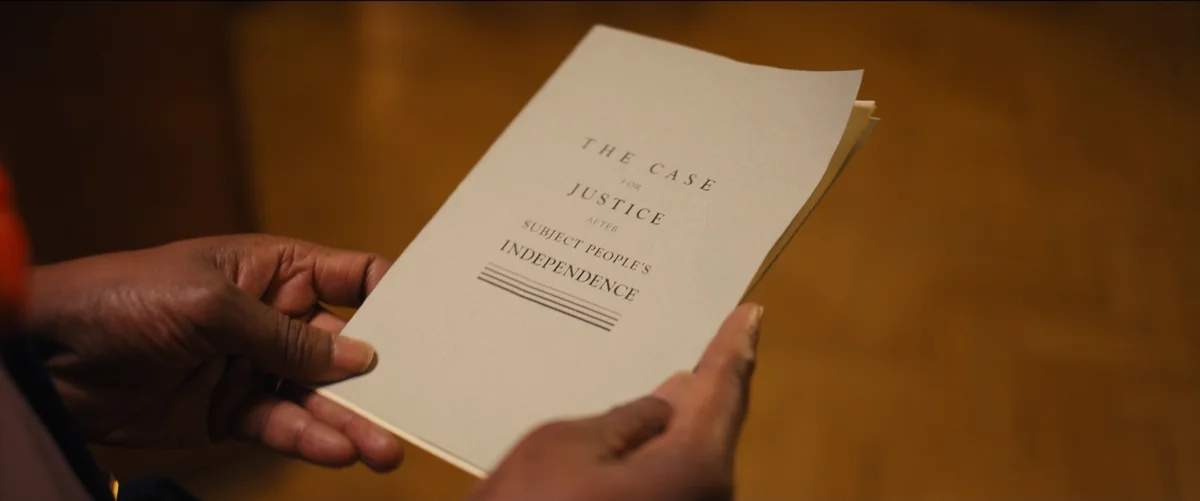
AL: Do you have an example of a specific filmic intervention where you did that: where you had to make a cut or add in narration to steer the viewer through that footage?
OI: I’m always wrestling with the idea of making things without narration, or making things without text, just to have the images. Often, I feel like I can’t just show these images by themselves: they need some mediation, some intervention. I figured out that being able to ask questions rather than making statements allowed me to direct an audience in a way, but I’m also conscious about not leading them too far down a particular interpretation. I want to leave the work open enough for me not to be didactic. You know, I have a certain interpretation of those images, but I feel like I’m not saying it; I’m asking a question that might lead the viewer to think about it.
I remember one time I was on a panel after I showed Specialised Technique [2018], and someone asked me about why I was sexualising the people in the archival footage.Specialised Technique is the third film in Igwe’s ‘No Dance, No Palaver’trilogy(2017–18), which uses critical proximity – the artist's methodology of ‘being close to, next to, with and amongst the various subjects suspended in celluloid by the colonial project’ – to speculatively explore the Aba Women’s War of 1929. There’s a moment when I project archival footage of a man dancing onto my skirt. And I was shocked. It was the first time I’d ever heard anyone say that. I was quite forceful: I was just like, no. I think that says more about the person asking it, actually. But, I don’t know. I don’t know. I’m curious about this.
What does it mean for me to put my body in something? And for me to recognise that my body is meaningful in particular ways that go outside of my own control and outside of my own intention? And that, when it is onscreen, my body exists separately from my sense of self. That’s where you get to these tricky moments where you’re just like, okay, if someone is going to read this as sexual, what can I do? There’s a limit to what I can do about that.
AL: I’m glad you brought up using your own body because that’s something I think about a lot. How Black filmmakers and feminist filmmakers who have experimental non-fiction practices use their bodies in their work. Is that something that you came to naturally or has it always been a loaded decision for you?
OI: I think it was unintentional. With Her Name In My Mouth [2017], those shots actually were tests.The first film in the ‘No Dance, No Palaver’ trilogy, Her Name in My Mouth,explores the transtemporal link between gesture and embodiment. Recycled footage from the Colonial Film Unit is cut alongside visuals of Igwe working with the archival material, speaking to a lineage of feminist protest. I was like, I’m gonna get a performer to do this, I’ll just test it out first. And then I started to think, I mean, I am the easiest person to recruit to be in my films, but also I found my presence a way of subverting how the colonial gaze works. The grammar of colonial filmmaking is that the authors are always absent. Their neutrality and objectivity are imbued within the object, but we never see them. It doesn’t allow us to know that this is a subjective take on something. And so I was like, okay, if I’m in it, then people know it’s me and they will make certain connections about my subjectivity based on my race and gender. So that is intentional. Because you’re only seeing me. You’re not getting to know my biography. I’m not talking. I’m just a body, you know? So that is also something. It’s been a few years since I last did that…
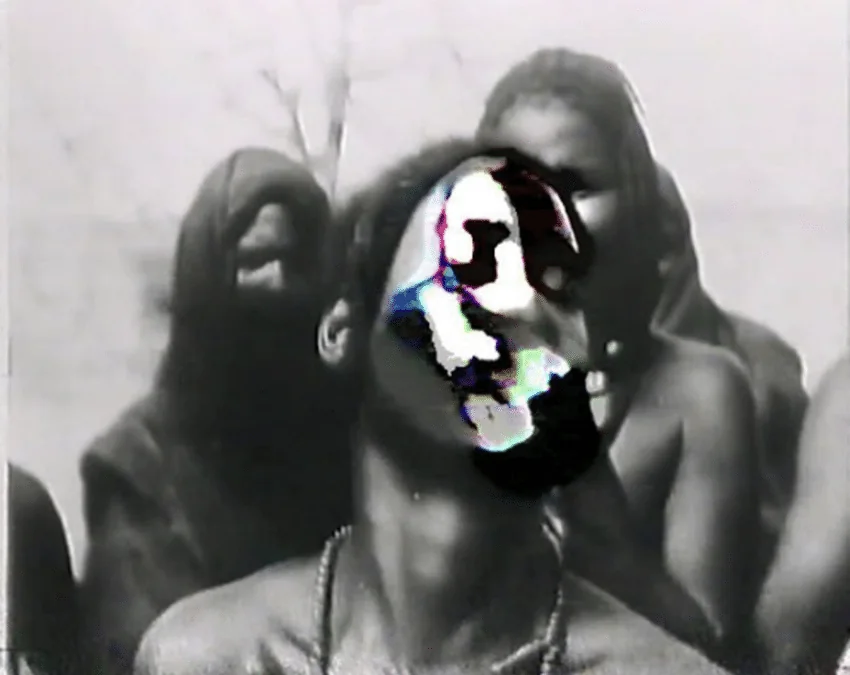
AL: I’m thinking of that shot in the film where we see you in a full body shot wearing a t-shirt of an unnamed woman from the colonial archival footage. Suddenly, a face we’ve seen only seconds before becomes identifiable and is transported into the present through the creation of a new image – one that you’ve created. It feels like an addition or a mimicking of the archive in a way that links your body to the unknown, unidentifiable face of someone else. I thought that was such a powerful visual. It reminded me of how you once described your artistic ethos. I remember reading something you wrote where you said something like: ‘I went looking for myself in the archive.’ This image speaks to that impulse.
OI: I want my work to start a conversation. I love it when I’m surprised by a response. But I guess because a lot of these films are shown quite a lot, sometimes I suddenly notice what they don’t say. For a little while, people only saw archives and I was like, this is annoying. Like, there are other things going on in my work.
AL: You’re the filmmaker in focus this year at Open City, showing what is essentially a retrospective of your work. Is this special for you?
OI: I have known about Open City since it started. I remember when I first went I was going to watch things as a student, after I had my MA in documentary filmmaking, and then I had the opportunity to show things. So it kind of feels in some way that we’ve had a parallel trajectory.
When they asked me to be the filmmaker in focus… Well, there’s something that feels strange about getting that request for a retrospective. I’m just like, I’m not dying, you know…
AL: [Laughs] You’re still actively producing work.
OI: Exactly. Like, do I even have enough stuff? And then when I started talking about it with the Open City team, I was kind of like, oh, this is a nice opportunity to think about showcasing my work in a slightly different way, about having some agency over how it is shown. So, I was thinking, what can I learn from this experience and which of my recent thoughts can I put into practice?
There were two screenings of my own work. I decided to organise the first one around ideas about landscape. And then, because I’ve been working with theatre more recently, I wanted to think a little bit about performance and about trying to experiment with the second programme, to incorporate some of my work that goes beyond the screen. So that programme has silent and sound works. I’m also interested in expanding cinema in some way: playing a little bit with what the screen can be.
I went to a performance by a friend of mine and she was talking about her ‘aesthetic tradition’. I found this concept kind of generative. And I started thinking about all these films that maybe I did see, maybe I didn’t, that were on television growing up. In the UK, we had these different series across the BBC and Channel 4, which showcased experimental work. And when I was like in my late teens, early twenties, there were these things called Three Minute Wonders on Channel 4, which are these very short, kind of interstitial programmes artists were commissioned to make. So I started researching these films and picked some in which I felt I could see my practice or which I felt could start some kind of conversation with my practice.
AL: Very cool. Why ‘accidental aesthetic tradition’? I was struck by that title for the second programme.
OI: Maybe it’s not even the right word? But there’s a way in which you’re perhaps given an aesthetic tradition, right? Like, you’re taught it, or your parents or someone passes something on. You’re working as part of a lineage. And I was thinking about this idea of catching something on television – maybe briefly, out of the corner of your eye. I kind of like this idea of a chance encounter, and that’s what I wanted to emphasise: that it’s cumulative; that if I look back now, I can see the ways in which those kinds of experiences would have accidentally broadened my perspective of what film could be.