
Painting a World of Rest With Marthe Peters
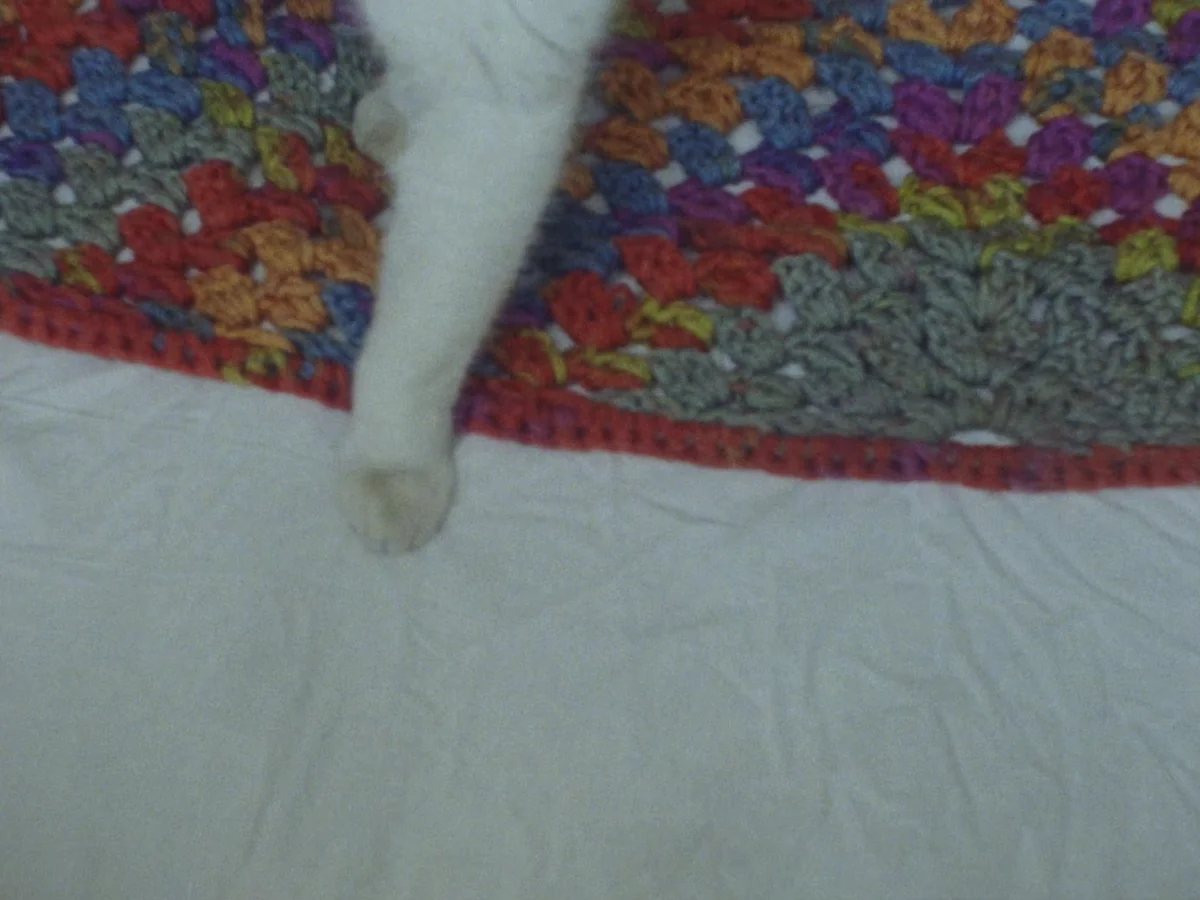
Structured around a letter to her cat, Henry, Marthe Peters’s Henry Is a Girl Who Likes to Sleep (2025) is a portrait of intimacy and the complexities of animal companionship. The film takes place, for the most part, inside Peters’s domestic space, where a tactile world of rest, care and exploration unfolds: duvets and blankets of various colours and patterns; plastic animal miniatures and shimmering snail trails. Embracing a hybrid form, the filmmaker adds an additional layer of tactility to these images, interspersing frames of painted celluloid through the film.
The intimate epistolary form can now be considered part of the filmmaker’s style. In her graduate film, Baldilocks (Kaalkapje, 2024), Peters revisits her childhood living with cancer through her parents’ home videos, which document their tired and loving gaze towards her. Alongside those analogue images, which capture a smiling infant with a nose tube, we also see fragments of Peters’s adult body, abstracted and scarred. Her frank voiceover creates a powerful bridge between her child self – ‘a clinical miracle’ – and her present self, as she undergoes invasive medical treatments and battles with complex fertility issues. Baldilocks is a gesture of reciprocal love and respect for her parents, tainted with a rawness and honesty that offers an alternative to heroic narratives about overcoming illness – although we hear her father in voice-off, wishing that he could make his daughter “a little bit immortal”. Peters is open to contradiction: elsewhere, footage of her young parents taking a smoke break overlaps with the more recent recording of a phone call in which mother and daughter discuss a shared smoking addiction.
In Henry Is a Girl Who Likes to Sleep, Peters’s onscreen body differs across two contrasting self-portraits of a woman at rest. One is grounded in reality, showing Peters nestling underneath a duvet in bed, and the other is surreal: in the early hours of the morning, she inhabits the empty streets of the city dressed in a giant snail costume made from felt. This soft shell, which protects a vulnerable body, might be interpreted as a call to imagine a different type of temporality – what disability scholars have termed ‘crip time’– where bodies move according to rhythms that resist the demands of neoliberal productivity. As she admires her cat’s shameless and unintentionally defiant state of slumber, Peters speaks of the ‘small’ injustices of an ableist and sleep-deprived world: one that forces bodies to, in the words of disability theorist Alison Kafer, ‘bend to meet the normative clock’.
Peters draws on other artists and thinkers concerned with rest and the frailty of the body across the film. A photograph shows artist Dennis Oppenheim lying on his stomach in the notch between two gravel hills, and Peters traces her hand over the contour of that artist's kindred, vulnerable body. Peters includes scans of Helen Hunt Jackson’s Letters from a Cat (1879), a series of playful epistles ‘written’ by a cat who misses its companion and finds solace in rest. A fragment of the book marked with pink highlighter reads, ‘I do think going to sleep is one of the very best things for people who are unhappy.’
From my description, it might seem like the film is all tenderness and sweetness. But like Baldilocks, Henry Is a Girl Who Likes to Sleep is knotty. Peters’s love-infused opening lines – ‘Dear Henry I love you, and I love how I am with you... You are my baby without a pregnancy’ – find a counterpoint in her professed feelings of guilt for projecting her ‘picket fence dream’ onto Henry; for ‘staining’ her with too much love and wanting to create a nest in her fur.
Ane Lopez: I wanted to start by asking about Baldilocks in relation to Henry Is a Girl Who Likes to Sleep. The former is a conversation between your past and present, and between you and your parents, while the latter delves deeper into your own present reality shared with Henry. There is a sense of continuity, but also redirection.
Marthe Peters: With Baldilocks, I never set out to make this big work about my trauma. I wanted to talk about a few different things – depression, vaginismus, feeling estranged from your body – and delving into my personal story made the most sense for that. I think I’ve always used film to dig deep into myself and make something very personal, but hopefully universal, for other people. But I was quite tired from doing that. I knew I wanted to find a way to sustain an artistic practice that was not exhausting, or that didn’t take everything out of me as Baldilocks had. I wanted to experiment and focus on a subject that was a little bit more outside of me this time – although I should have known that it would be just as intimate in the end. But the way I worked was quite different; it didn’t ask so much of my mental health. I didn’t intend to make a film that would only make sense if you’d seen Baldilocks. But I have noticed that, when people have seen Baldilocks, or have experience with chronic illness themselves, they read Henry Is a Girl differently. I thought a lot about whether I needed to make explicit why I lie in bed so much of the time, but I decided to talk about it more abstractly.
AL: I’m really interested in your narration and the epistolary form within it. It feels like there are some things that can only be said via letter, and the writing is so powerful. I wanted to ask how you approach it.
MP: Thanks for saying that, because I’ve noticed how differently Dutch and English speakers perceive the voiceover. A Dutch person said to me that they thought my choice of language was really particular and old-fashioned – that’s just how I like to write – but, of course, this doesn’t really translate into English, so I’m glad it still resonates. I went back and forth a lot and I read a lot of theory for this film specifically, though I don’t know if that really comes through. But it was difficult to apply theory to the film because I like to use more poetic language.
In terms of the letter writing, I’ve always noticed there is an ease to it. I’m not really a letter writer in real life; it’s just a really approachable way to write. Working on a voiceover, you have the audience in mind, but when you are writing a letter to someone, you have that person in mind. I’m going to be completely honest: although the letters are addressed to Henry, I didn’t really have Henry in mind the whole time. I didn’t want to impose my feelings onto her. I wanted to make a film critiquing that projection. I think the letter form was a way to be honest about that. Baldilocks, in a way, was a love letter to my parents – even though it wasn’t explicitly phrased as a letter – and this film is a love letter to Henry.
AL: I think your film is really generous, and there’s this softness and closeness I was really touched by. The sound has an ASMR-like quality that brings the viewer closer to the image. Could you talk about your choice of sound and the fluttering piano music?
MP: So, first of all, I hate sound. I’m really bad at it. I usually like to edit just with the visuals first, before bringing the voiceover in. I never really edit with any other sound at first, but the rhythm of the voice. And then I experiment with white noise, like the sound of a Handycam for example. But this time I worked on most of the sound with my partner Leon, who has a lot of knowledge about sound. As for the soundtrack, I had never worked with music before, and I wanted to avoid creating a soundtrack that guides the emotions, but at the same time I was really intrigued about trying it out, as I had access to a grant for filmmakers to work with musicians. I work at a cinema, and we have a programme where musicians reimagine the soundtrack of a film. Maya Dhondt was part of one of these programmes, reimagining short films by Josephine Massarella, and I thought, That’s exactly what I want! We worked together through a back-and-forth conversation; I would make an edit with images for Maya to improvise with, then I would continue editing in response to that music, and so on, until I sent the final edit to her and she created the final piece of music. She’s really talented. The music has that warmth that you sometimes feel in church from gospel pianos, which was my inspiration.
AL: How was the process of assembling all the different techniques in your film? There are drawings on celluloid, gel pen line drawings on paper, found footage, paper cut-outs…
MP: I always try to find very material ways to make films. Sometimes I really wish I was a painter so I could make something physical. With film, there’s this sense of disappointment, because I’m working on something for a long time which I can’t even touch. I wanted to work in a more tactile way. And I think that’s where the drawing comes in. Two years ago, I went through a period where I was in my head a lot, and I really love to read but I couldn’t concentrate, so I started working on these colouring pages with gel pens. I became obsessed with gel pens because they flow over the paper in such a nice manner, and they kind of remind me of snails as well, but that’s only a correlation I’m making in retrospect. I often start thinking about a film in progress through one colour. Baldilocks was yellow and this one was pink. It always helps me to have something like a colour as a thread that ties things together.Colour is more important for me than composition. And I think I often use the camera to paint as well: I zoom in a lot and then I get these different coloured pixels and textures.

AL: I think that painterly element really comes across in scenes like the one in which you cover and strip the bed of different coloured and patterned duvets. Although you are talking about stillness and horizontality, there are these waves of movement and dynamism in the film.
MP: I’ve never really been able to edit really static images. That’s not how we see the world. Like, even if I just look straight ahead, there’s still going to be a bit of movement, and my eyes are moving and landing on different details. I’m not sure. I’m going to have to write a paper about that, maybe.
AL: You mentioned you read a lot of theory while you were writing and I wonder if you wanted to share a bit of that journey and what you learned?
MP: I learned so much. I started with Radical Companionship [2021] by Aiyana Goodfellow: a manifesto critiquing the way we handle pets and the way that we slot them into our lives, like they are objects. Goodfellow writes about how we consume them in the same way we would consume meat. We don’t eat them, but it’s still consumption because they have to serve us and they have to adapt to our lifestyles. I was also interested in ‘cutefication’. We usually talk to animals using this quite high-pitched voice, in the same way as we talk to babies: as if they had no agency or were a bit stupid. I still do it, but I try to do it less. John Berger also wrote about the consumption of animals in his book Why Look at Animals? [2009].
And from there I went into anti-capitalist critique, including Tricia Hersey’s Rest Is Resistance [2022] and Jonathan Crary’s 24/7 [2014]. There is this element of resistance to sleep, because it is the only moment when we are not being productive, and capitalism is trying to lessen our need for sleep so that we can maximise our productivity. This is really a space that we need to protect. And of course I am looking at sleep from the angle of chronic illness – I sometimes can’t get out of bed when I wish that I could – but also from wanting to kind of shine light on the importance of sleep and the importance of rest for others. There are people who get only four hours of sleep a night and it makes me think of what Hersey says: that of course there is less critical thinking if you’re tired all the time. There’s this whole sense that you’re only valuable if you’re productive which ties nicely together into this idea of pets.
Having said all of that, theory is something I really struggle with. Deborah Levy has this quote that is amazing: ‘I don’t like theory or psychoanalytic theory to stamp its muddy boots all over the pages of my work. I want the work to be light on its feet. A bit like swimming, like a current, an undertow that could carry you out to the wild sea.’ I think it’s so beautiful.
AL: I really like this line in the film that says, ‘I would like to donate some of my horizontal time’, and the tension that it creates.
MP: Yes, Tricia Hersey, whom I mentioned, is a Black author, and Rest Is Resistance is really about people of colour, and I’m not a person of colour. And I am aware that I’m an artist with access to benefits in Belgium [Peters is Dutch and lives in Belgium]. I know that I’m really privileged that the state provides this, and it’s really good for me as an artist, but it’s also really good for me as a chronically ill person as I get to make my own schedule and I can work from home, from my bed. I just couldn’t work from nine to five in an office five days a week, because I can’t be sitting up all the time. I have the chance to sleep in if I need to sleep in, but I am very aware that not everybody has this luxury. I call it a luxury but it’s also a necessity. I felt a bit strange about making a film about how important rest is when I know that it’s simply not available to everyone, and that’s horrible. And I know that it’s not because other people can't that I shouldn’t rest as much, but I still wish people could sleep more. It’s complicated.
AL: Are there any interactions you’ve had with audiences or any personal responses to the film you would like to share?
MP: Two people told me that they watched the film in bed while going through a physical flare up, and one person watched it with their dog. That’s really special and meaningful to me. Of course, I really appreciate seeing my film on the big screen, but perhaps watching it on a laptop in bed is the ideal setup for this film. To me even if only one person feels seen by the film, then it was all worth it. I’ve felt quite shit for a lot of my life, with mental and physical illness, and sharing and talking about the experience really helps me. I hope others can feel less alone too.