
After the Hunt
Luca Guadagnino’s After the Hunt begins with the non-diegetic sound of a ticking clock. In the context of this sleek campus drama, that menacing sound might represent the ‘tenure clock’. Whether Yale will grant tenure—protected, permanent employment at the university—to either Alma Imhoff (Julia Roberts) or Hank Gibson (Andrew Garfield) will structure the events that follow. Tenure is important in this film, less for the material security it will provide one of these philosophy professors, than because it might offer freedom from accountability: the liberty, as Hank puts it, “to follow an impulse without fear of systemic reproach”. This is hammered home in a series of scenes in which Alma discourses on “collective morality”, reducing Kierkegaard, Adorno, Arendt, Hegel and Foucault to vague points about the “court of public opinion” and the panopticon state in which citizens police one another.
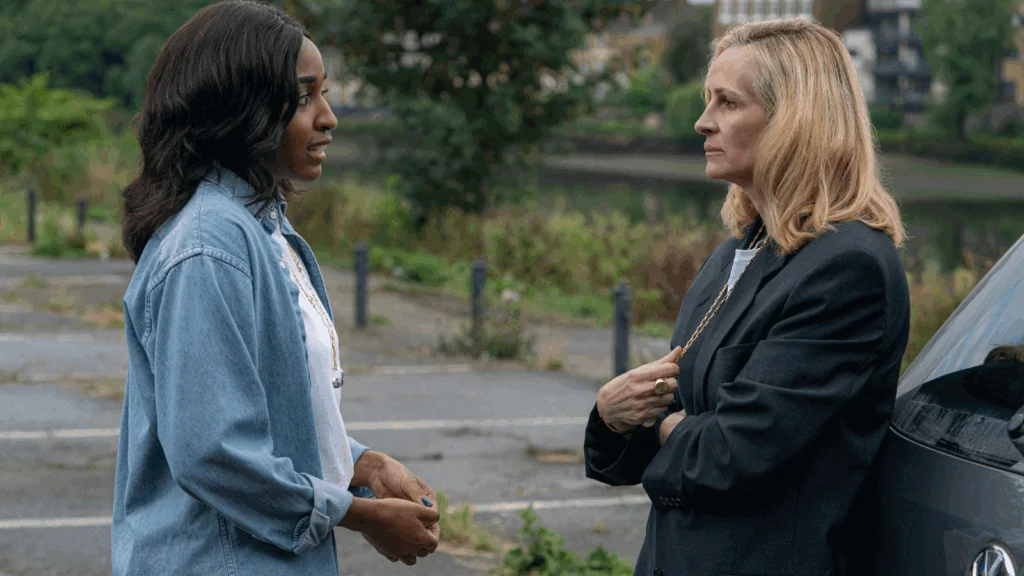
Set in 2019, with an epilogue that takes place five years later, After the Hunt attempts to dramatise the campus power dynamics that became a primary focus of the MeToo movement. The film begins with a party in Alma’s lavish home during which the lines between public and private blur as students and teachers drink together. At the end of the night, Hank, who we have seen sitting legs apart with a wine bottle in his lap and his shirt unbuttoned almost to the navel, walks a student called Maggie (Ayo Edebiri) home. According to Maggie, he then came in for a nightcap and sexually assaulted her. According to Hank, he went in for a nightcap and accused her of plagiarising her dissertation from Giorgio Agamben. Neither Guadagnino’s direction nor Nora Garrett’s script ever disclose what actually happened but, in the paranoid tradition of David Mamet’s Oleanna (1992), we are encouraged to see Maggie—who is Black, gay, and the daughter of important donors to the university—as suspicious . We can see that she is trying to get Hank fired, but her motive for doing so is unclear.
And Hank is fired, with improbable speed. This leads to a painfully overblown scene in which he quotes the trial scene from Shakespeare’s The Winter’s Tale and rampages down a college hallway, tearing down posters and kicking over bins while a group of students look on in pantomimic horror. Hank’s prophecy that this accusation would ruin his career has come true: it was her word against his lifetime of hard work, good deeds and “advocating for women in philosophy”. (This line, admittedly, made me laugh.) After the Hunt, on the other hand, is lazy about advocating for Alma. We are clearly meant to believe in her as a philosopher and as a teacher, but there is very little evidence as to why her students might feel enamoured with her or supported by her. The film seems satisfied with relying on a vague cultural memory of Roberts playing a feminist professor at Wellesley in Mike Newell’s syrupy Mona Lisa Smile (2003).
Many reviews of After the Hunt have been critical of how clumsily the film handles cancel culture and campus politics more generally. Given the recent criminalisation of campus protests against Israel’s genocidal assault on Palestine, the film’s ‘these Gen Z snowflakes don’t know they’re born’ attitude feels offensive as well as tired, as does one joke about a lecture titled “The Future of Jihadism is Female”. With Alma decrying identity politics and instructing one student to “pad your chosen cell with niceties and fucking trigger warnings”, the film invites obvious comparisons to Todd Field’s Tár (2022), which includes a similar classroom meltdown; there are echoes, too, of Netflix’s The Chair (2021). Guadagnino textures his film with references that attempt to make it a learned cultured object: there is a strange in-joke about Henrik Ibsen, and Thomas Mann's Buddenbrooks sits prominently on Alma’s bedside table. When Guadagnino was asked about the film’s end credits, which seem to pay homage to Woody Allen, he described Allen as “an artist who had been facing some sort of problems with his being”, which is an interesting new euphemism for alleged paedophilia.
After the Hunt mistreats its material. Eva Victor’s sensitive, funny Sorry, Baby (2025) offers a useful counterpoint. In this film, too, the audience is told about but never shown the sexual assault of a graduate student, Agnes, by her professor. But rather than constructing a game of ‘he said, she said’, Sorry Baby makes a feminist choice: it takes Agnes at her word. She discloses what happened to her best friend and fellow student, who believes her immediately and completely without requiring specifics: the act itself is named only as ‘the bad thing’. Victor’s camera remains steady on Agnes’s face as she describes as much as she can of what has happened to her, in her own time. Rape does not need to be described to be identified, especially in an institutional context littered with historical and cultural examples of such abuses of power. Throughout Victor’s film, Agnes’s right to refuse to describe her experience is defended against the many cultural and institutional imperatives to do so, whether in the courtroom, the bedroom, or the doctor’s office.
In After the Hunt, Alma pushes for specifics—“What are you actually saying? What actually happened?”—with Guadagnino’s rapid cuts between the two women’s faces feeling adversarial, as if intentionally rousing the audience’s suspicion. Maggie replies: “He assaulted me. How much else do you need to know?” Later, when Alma apologises for her reaction, saying it wasn’t “easy news” to hear. Maggie responds, “Try telling it.” Testimony, the act of telling and how that might be interpreted, is certainly central to the film, though I’m not sure Guadagnino and Garrett know what they’re trying to do with it. In a convoluted plot twist, we learn that Alma once invented a story of sexual abuse.
*
I thought I was going to see a badly executed film about universities. I didn’t expect there to be a badly executed—and more interesting—film about psychoanalysis inside of it. In one of the first interactions between Alma and her husband Frederik (Michael Stuhlbarg), she baits him: “Freud was a misogynist, darling.” Frederik, a psychoanalyst, replies, “It was a different time, darling.” By questioning the reliability of Maggie’s testimony, then introducing Alma’s historic, fabricated accusation, After the Hunt engages with an aspect of psychoanalytic history that remains controversial, especially within feminism. In Freud’s early seduction theory, he argued that repressed memories of childhood sexual assault were at the root of some hysterical symptoms. He later suggested these memories were invented by the female patient; an unhelpful legacy in a wider culture that still refuses to fully engage with the contested site of sexuality, or with abuse and its complex relation to memory. For a moment, After the Hunt seems like it might be pursuing this ambiguity: Alma, comforting Maggie, responds to the younger woman’s insistence that “it really happened”, with “if it’s real to you, it’s real”. But this productive ambivalence never comes up again. There is no room for it, in a film with such a relentless pace: while Sorry, Baby ’s non-linear narrative mirrors the temporal experience of trauma, Guadagnino wants to take the audience from A to B, with no detours.
The film’s characters take turns playing the analyst. First, Alma is Maggie’s, but after the student discovers her teacher’s history she tries to switch roles, suggesting that Alma’s past experience is colouring her present response. In addition to this paint-by-numbers version of the return of the repressed, Frederik takes on a therapeutic relation to Alma in the film’s denouement. Alma, who has spent much of the film in pain and vomiting into a series of toilets, collapses as a group of students crowd her at a campus protest. Her mysterious illness is both a hysterical symptom, a manifestation of her buried secret, and a more mundane medical deus ex machina: multiple perforated ulcers. As Alma lies on a hospital bed that may just as well be a therapeutic couch, she tells him the truth of what Maggie discovered in an article hidden beneath the sink in the downstairs bathroom: the subconscious of the house. She and her father’s best friend kissed after her fifteenth birthday; it led to a relationship; they were “in love”. When he broke off the affair, she accused him of abuse. It’s a relief when Frederik clarifies that it was still abuse: statutory rape. “Young girls want adult things to happen to them,” he continues, but it is always the adult’s job to protect the child. Frederik is the only person in this film who seems like he might actually be good at his job.
After the Hunt does not engage with the psychoanalytic problems it gestures towards. A more complex film might have asked how an institution can legislate on desire and consent if, as Freud suggests, we can never truly know what we want. It might have better illuminated what we know for sure. Erotic life is cloudy and complex, and it can thrive on asymmetry. But the university is not there to police private expressions of desire (an impossible task). Rather, its job is to protect its students from the repercussions of that desire in their place of study.
In missing this opportunity, the film also misses the chance to convincingly, or interestingly, portray sexuality in general. If After the Hunt does not quite hate lesbians, then it fears them, adhering to tired doppelganger stereotypes. Maggie dresses like Alma, adopts her mannerisms, and confesses in the epilogue, “I wasn’t sure if I wanted to be you or be with you.” We’ve seen and heard it all before. Maggie’s obsession with Alma—diagnosed jokingly by another character as an Elektra complex—is ultimately implied to be the impetus behind her accusation against Hank. Alma, for her part, charges her with seeking another adoptive mother, following up with a note of high school homophobia: “Thank you, but I already have a husband.” But Maggie is in a relationship too. Alex (Lío Mehiel) is an interesting character despite the film’s dismissal of them as a partner chosen simply because their non-binary identity makes Maggie more interesting, with Alex the foil for an excruciating, Tár- lite moment, played for laughs, in which Alma shouts at them “They, go away!” Mehiel does a lot with very little. When Maggie is upset, Alex comforts her, asking first if it is alright to touch her. In a film that seems completely uninterested in the complexities of consent, that never considers Maggie’s sexuality as something which provides an additional dimension to Hank’s violation, this moved me.
*
I studied at the University of Cambridge, on the grounds where some of After the Hunt was filmed. Elite higher education institutions are siblings, and not just architecturally. Scenes in After the Hunt in which staff and students drink alcohol, free and free-flowing, in intimidating wood-panelled surroundings, could be swapped out for many of my own student experiences.
Later, I taught at a variety of institutions, including some very wealthy ones. Something that became increasingly untenable for me during those years was the dissonant experience of my own hypocrisy. I would sit in my office (when I had an office), its shelves full of feminist theory, a Paula Rego print framed on the wall and a first edition of The Golden Notebook on the mantelpiece, and neutrally explain the specifics of the university’s sexual misconduct complaint process to students who came to see me in distress. I knew that if they asked me for my own opinion about whether they should go through with it, I would have to say no. I submitted such a complaint during my student years: it was extensive, exhausting, and unsuccessful. It wasn’t worth it.
Alma is right about one thing. If you publicly tell a story about sexual assault, you risk the fact that “it, not your work, is all anyone will see when they look at you”. You might want to trust the system, she continues, “but it won’t help you”. Alma and Maggie go on to argue about whether the right to speak out is compromised if someone you respect—someone more powerful than you—advises you against using it. It recalls an argument earlier in the film about whether Maggie should attend a lecture at which Hank already present. “I have a right to these spaces,” Maggie says, and she’s right. “You don’t have to go in there,” says Alma, and she’s right, too.
The university complaint process, as the feminist scholar Sara Ahmed writes, is designed to do two things: to protect the institution and to exhaust the complainer. When you complain, Ahmed contends, you become the problem. After the Hunt could, in a generous reading, be seen to be dramatising this insight by transforming Maggie into a monstrous problem. Yet, in the end, Alma’s tenure clock is paused not because of how the assault case escalates, but because of an unrelated misdemeanour. I think the film is trying to make a point about irony, suggesting that Alma’s cynical, careerist decision to support Maggie to appease university management, and not to stand up for Hank and the side of ‘truth’, was ultimately all for nothing.
I thought it went without saying that university management would not reward anyone for taking a student’s side against a member of staff in a sexual assault case. It is true, however, that institutions are much more fluent now in the language of solidarity and support. See, again, Sorry, Baby, in which two women from HR tell Agnes that, due to a bureaucratic loophole, there is nothing they can do to pursue her complaint against her professor. They assure her, however, that “As women, we know what you’re going through.” The language of feminism is often manipulated to obscure institutional misogyny. Alma’s “why me?” question when Maggie discloses her assault could be interpreted as a comment, from a woman we’re repeatedly told has succeeded against the odds in a male-dominated field, about who the time-consuming, pastoral labour of supporting students who have experienced sexual misconduct gets delegated to.
The tagline of After the Hunt comes from a scene that feels like it was written so it could be used as such. During an argument, Alma tells Maggie, “Not everything is supposed to make you feel comfortable.” Having a straight white professor say this to a gay Black student at Yale in the wider context of a second Trump presidency feels unnecessary at best. I agree with the premise: the question, though, is about which forms of speech generate discomfort for those in positions of power, and which generate discomfort for those less powerful than them. The point of an education is to think about things that may not feel comfortable; the point of the classroom is to create an environment in which everyone can do that thinking.
Helen Charman is a writer and academic. Her first book , Mother State: a political history of motherhood, was pulished by Penguin/Allen Lane in 2024