
From Landscape to Environment: Laida Lertxundi on Películas
Laida Lertxundi's films interweave natural and social environments. Stemming from her determination to push the limits of form and to explore the sensuality of moving images, Lertxundi's films stretch the medium in order to defamiliarise its components, thereby questioning cinema’s most basic assumptions: narrative, performance, script.
Lertxundi's process is eminently open and collaborative, allowing for poetic ruptures that render the world in both familiar and unfamiliar terms. Her films move indiscriminately from indoor to outdoor spaces, registering how landscapes become inhabited through bodily experience and seemingly spontaneous dialogues. In works like Autoficción (2020) or Double Séjour Situation (2024), words don't fix meaning, they release it. The presence of friends and colleagues gives Lertxundi's films an understated style, often derouted by her surprising editing choices, and the creation of nuanced emotional atmospheres. People appear in relation to space and to one another, but dynamic distances can be observed between them, sometimes caused by what we imagine to be their real-life relationships, and others by the framework of performance. As Erika Balsom has described, Lertxundi's films exist ‘between the stability of structure and the mutability of affect’. They generously engage with everything that surrounds the filmmaker, bypassing the self and letting the unsuspected textures of the world in.
Born in Bilbao, Spain, Lertxundi moved to New York City to study art and cinema, and later earned her MFA from CalArts in Los Angeles, where she lived for almost two decades, teaching art in different schools. During her time in the United States, she produced films that playfully engage with landscapes characteristic of Southern California, such as the desert and the ocean, and rethink the urban aesthetics of Los Angeles by exploring corporeality, domesticity and nature. In these films, she experiments with the boundary between diegetic and non-diegetic sound. In Cry When It Happens (2010), for instance, The Blue Rondos's ‘Little Baby’ plays at startling moments from different sources and accompanied by myriad accompanying noises, creating a layered soundtrack. She has explored autobiographical questions, too, albeit indirectly, as in 025 Sunset Red (2016), which references her upbringing in a Communist family through the use of recontextualised archival materials – the presence of which is made almost spectral by the film's poetic displacements. Here, again, a juxtaposition of elements multiplies thematic resonances and prevents us from imposing a single interpretation.
In 2020, Lertxundi returned to her native Basque Country. She taught filmmaking at the Elias Querejeta Zine Eskola, and made films including In a Nearby Field (2023) and 8 Topaketa (2021–2023), both of which deal with collaborative filmmaking experiences. Recently she moved to France, where she currently teaches at the École Nationale Supérieure des Beaux-Arts de Lyon.
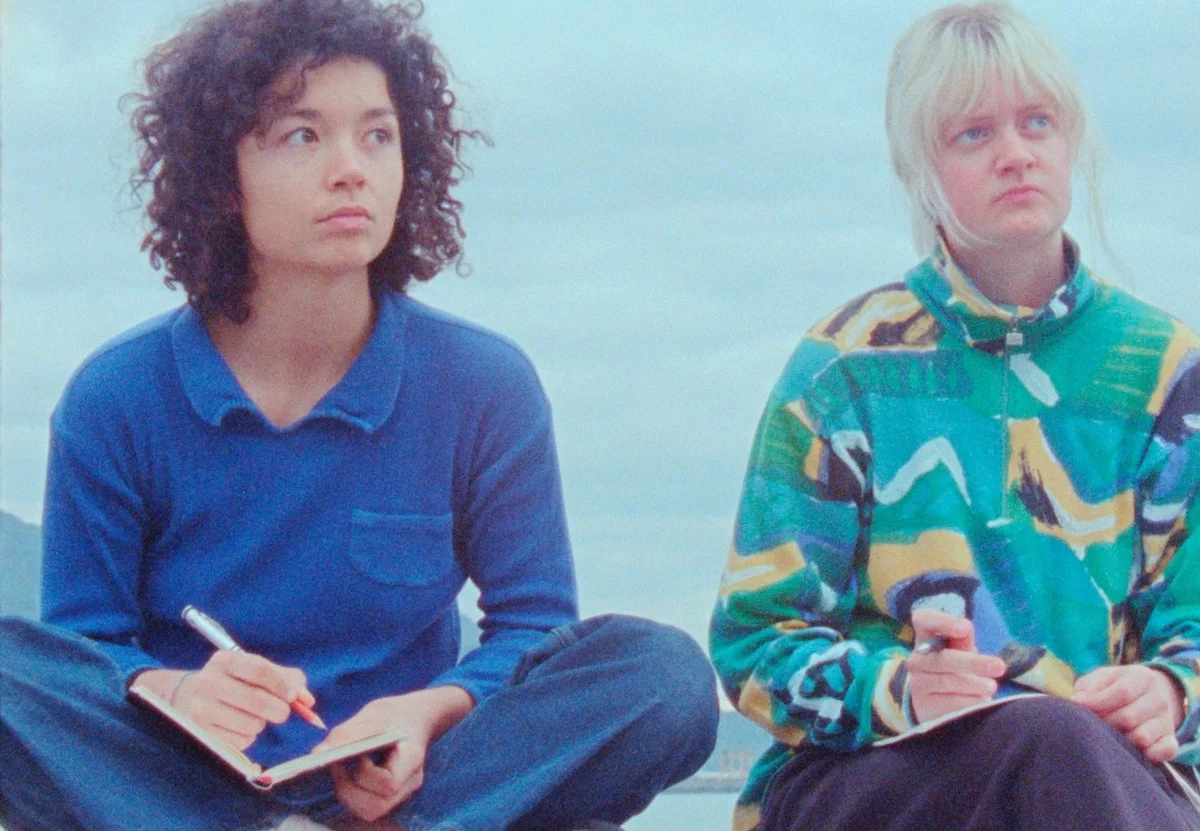
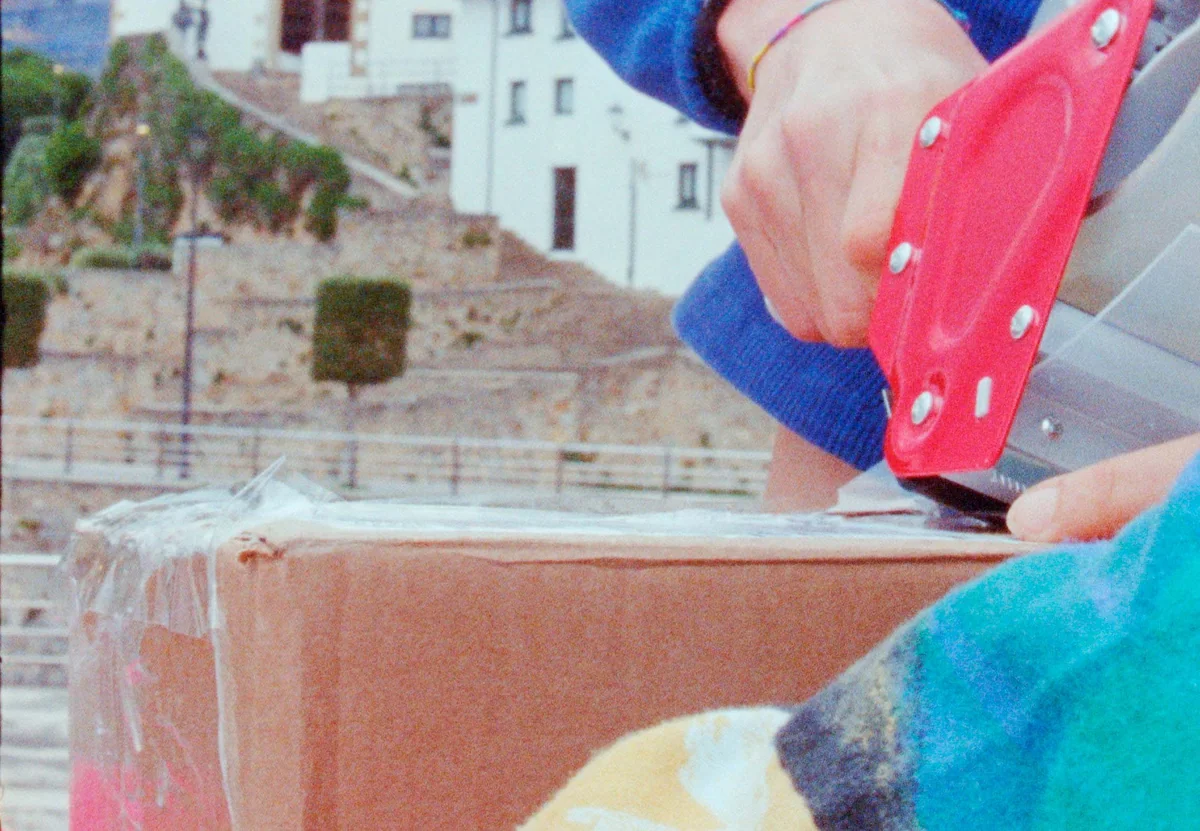
Originally part of her multimedia exhibition at San Sebastián’s Cibrián gallery titled Colour, like a hormone, Laida Lertxundi's five-minute Películas (2025) was screened at Open City Documentary Festival as part of the combined programme entitled ‘Woven’, which loosely gathered films about craftmaking across different media. Películas opened the screening. It set a simultaneously conceptual and sensuous mood, coming before two longer, more documentary-style works. Películas begins with two women scribbling in notebooks in front of a maritime landscape in the Basque Country. Irregular pieces of cardboard partially hide the view, creating compositions that blend natural and man-made surfaces. Then the women pack a cardboard box with film canisters and move somewhere else. One of the women has film projected onto the top half of her body: she gazes down at scenes filmed in nature, and images of another woman's pregnant belly and a tangerine floating on water. Spectatorship is duplicated. While ambient sound envelops the beginning of the film, the projection scene takes place in silence.
During a Q&A with the filmmakers of the combined programme, a member of the audience asked them all to describe the process of constructing the narratives of their films. Laida explained that there simply is no narrative in her work. Before we began our conversation at a bar in London, she wanted to clarify what she meant.
Laida Lertxundi: I felt combative after that question about narrative, because I disagreed with the question itself. I think that when people use the word ‘narrative’ they mean something else, like meaning or logic. There is a lack of imagination in thinking that there’s a narrative behind every film. Just because something happens over time, it doesn’t mean that somehow there’s a story. I felt like the scope of that conversation only allowed for two categories: something’s either narrative or intuitive, and intuitive means that you didn’t really plan it. As if there weren’t conceptual or material logics behind experimental cinema, or all these other ways to think about how to make a film which have nothing to do with fiction. I started making cinema because I discovered films that were explicitly non-narrative.
Irene Rihuete: I agree that everyone means something different when they talk about narrative. It can also be a way of thinking about the temporal unfolding of a film. How do you develop the idea for a succession of shots; what guides your design of temporality, rhythm and movement? Thinking about Películas, how did you come up with the film?
LL: For me, generally, there’s a huge divide between the shooting and the editing of a film. In the case of Películas, I had spent two years organising a film school with different groups of people in the mountains of the Basque Country, and it was very collaborative. The school was completely open to the public, and the shoots were almost like performances: an end in themselves. It wasn’t about the object that came afterwards, but the collective act of filmmaking in a specific environment. By the end of that experience, I had a lot of material, which I decided to include in Películas. The footage that the woman is projecting onto herself and watching constitutes an archive of this project. I like the short form because it allows for this kind of density. I’m interested in the idea of a minor literature, or a minor cinema, as opposed to a five-hour film, because in shorter works you can really see all that’s refracted through the image. In Películas, there are actually two temporalities: there’s the time of the two women, and then there's a re-projection of a previous moment, and these two moments collapse into one another. I think of the films of Pat O’Neill, who used to do a lot of optical printing, and also mixed different moments in time.
IR: Películas was part of an installation. Could you tell me a bit about that?
LL: It was an exhibition I had at Cibrián called Colour, like a hormone, which is from a poem by the writer Lisa Robertson. Películas was high up on a screen, and underneath was the box you can see in the film, with reels inside it. Some of the images from Películas were printed onto glass, like sculptures that had sound in them. There was another movie, and a lot of printmaking works. It was a huge amount of new work and all the pieces were in dialogue with each other. In fact, I thought of the exhibition as analogous to the making of a film because installing the different pieces was a form of editing. I experienced it like a piece of expanded cinema.
IR: What is your thinking when it comes to the difference between screening Películas in a cinema and showing it as part of an exhibition, particularly in terms of spectatorship?
LL: I have been thinking about this question a lot lately because I have been working on more exhibitions over the past decade. I enjoy having this kind of expanded cinema practice within the gallery space because it allows me to work across mediums other than film, and to possess a whole space through my ideas, as opposed to being part of a group programme, which is how short films are normally presented. In the cinema you know that you’ll have more of people’s attention, it’s much more of an event, but in the gallery space you have a lot more freedom and it’s less demanding. People choose how long they look at something; they’re not a captive audience in the same way, and I like that. Películas is in-between those worlds for sure. Now I’m working on two exhibitions which are coming up this summer, and I feel like making Películas definitely opened something up. I’m going to keep developing work that combines moving images, multiple screens and other media in space.
IR: Landscape is very important in the film. In the first part, it is brought to the foreground through a simple collage composition. What interests you about cinematic depictions of landscape? How has this interest evolved since you left the United States?
LL: My first filmmaking experience was filming landscape. I studied with Peter Hutton in New York, and he would take us on boats down the Hudson River to film nature. Then, at CalArts, I studied with James Benning, and we would travel to landscapes all over California. I think being Basque means that I already had an inbuilt relationship to nature, to being outdoors. Filming landscapes was also a way to own something temporarily, since you are in a space where you can make something freely and no one bothers you. The Basque is my original landscape; it’s a very ancient place. When I’m there, I just feel the need to go to the mountains. Having arrived from the States, organising the film school in the mountains was a way to find collaborators and reroute myself through my own practice in the place where I grew up.
Going back to what I was saying about narrative, I feel like sometimes we want films to be intelligible, we want them to answer the question: what is this film about? There’s an amazing Raúl Ruiz text about shamanic cinema where he says he wants to see films that avoid this. Sometimes people ask me: how do you find your subject? Well, I don’t go out looking for a subject. I find an environment. And an environment usually includes landscapes, but it also includes people. My films register the places I have inhabited, and the people who were inhabiting these spaces too. Film and sound are anti-narcissistic mediums; they make you want to record the world. I have never been interested in my own story or in me as a subject. I feel like film is designed to absorb the environment; it has a front-row seat to reality in a way that other arts don’t because of the negative, because of how something gets imprinted.
IR: That shift from landscape to environment is very interesting because landscape implies a two-dimensional perspective, whereas the notion of environment connects you to a more sensual understanding of the experience of being in the world.
LL: Yes. It’s everything that's around you: it’s people, it’s things, it’s nature. In Películas, you can see the ruins of the industrial port of Bilbao behind the two characters. The film is about the characters but also about everything that surrounds them, even the characteristic grey light of the area.
IR: What are the two characters doing in the scene in front of the port?
LL: During this mountain school, and during the years that I was in the Basque Country, I did a lot of score writing, a lot of exercises that are then enacted in film. I work with non-actors, so it’s a way of saying to them: this is what you’re going to do, you don’t have to act, you don’t have to be nervous, you’re just going to do this action. In Películas, the two women were writing down with their dominant hand what they thought would happen in the film, or how they wanted to participate, and with their non-dominant hand they were responding really quickly to those prompts. It was an exercise in accessing the unconscious, the non-logical. This is something that I have been very interested in for a long time. Lately I have been reading the work of Marion Milner, a psychoanalyst who talked a lot about the relationship between art and the unconscious. This is why the logic of narrative or the idea of having a subject doesn't really work for me, because I’m just much more interested in improvisation, in the unknown, in unconscious desires and obsessions. Like when you are drawn to something and you don’t know why. In my films, usually there’s some kind of event or formal thing that I want to see happen. For instance, when I was living in the States I had to get an electrocardiogram. I gave it to a musician and we started thinking about the body producing these forms which we could then turn into sound. One event becomes the axis along which something happens, materially or formally.
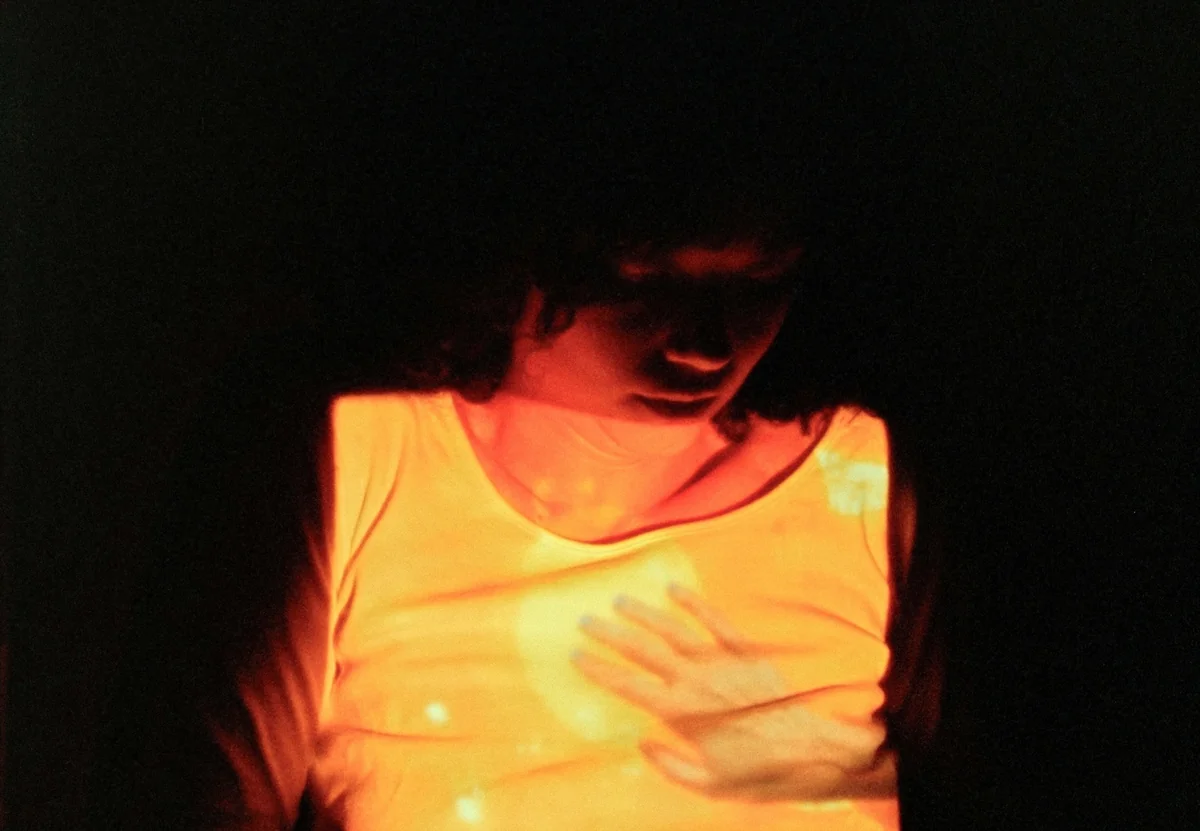
IR: This exploration of the body as an event reminds me of the pregnant belly in Películas; its projection onto the chest of one of the characters. How do you approach the body and the senses in your films?
LL: Perhaps in connection to my interest in the unconscious, that moment was a way to make the film more sensorial. When you have a thesis that is imposed onto a work it’s very difficult not to think about it from that point of view. So, if there is no clear thesis, then these other things can be activated in the experience. I’m already looking at way too many headlines and texts that are really tangible and language-based. With film, I’m interested in going to these other spaces. I want to have an experience with my body when I’m watching a film, and I want to be able to create that when I’m making films with someone, and when someone watches them. There are so many parallels between the pregnant belly and the film reels that are put in a box: something that’s in the dark, that is full of content, the idea of two spaces existing in one. A pregnant woman is kind of two beings. When you start getting close to birth, which this belly was, you start entering another realm of consciousness. That’s why the film is so dense. A pregnant woman or pregnant belly is so evocative, it’s intriguing for everyone. It creates both anxiety and desire.
IR: Going back to the question of landscape, there is a moment in the film in which a shot of the sea is partly covered by a broken piece of paper. In other works of yours, like Double Séjour Situation, there is also a modification of landscape with visible colour filters made of plastics. Is this a way of defamiliarising landscape?
LL: Yes. In that shot, I was looking at the sea where the province of Vizcaya ends. We were covering the image with paper and breaking it so there would be tears or holes, and you could see the landscape through them. The landscape here is partly veiled and partly shown. I call this ‘landscape plus’, because I bring to the environment something that does not belong to it – an obviously foreign object.See Laida Lertxundi's first monograph Landscape Plus (Mousse, 2019). In order to avoid the idea that I’m just documenting something in a naturalistic way, I always include some kind of element that doesn’t fit. In Vivir para vivir (2015), there’s the sound of lions emerging from speakers hidden among bushes. I like to incorporate something uncanny that confirms that this is not a straightforward document.
IR: Is there a specific affect or mood that you are interested in producing? I am also curious about the role of beauty in your films.
LL: Yes, much like I have always wanted to deconstruct narrative space, I also work against easily identifiable emotional states. I think of the films of David Lynch as an example of these very complex states: you sense desire and longing, but you know that something really bad might happen. These are very layered feelings that you can’t really put into words. I’m interested in playing with emotional anticipation and not delivering emotions in an expected way. This is also produced by the intimacy of working with very small groups of people and the fact that they’re all doing technical things, since there’s no division between cast and crew. This creates a close relationship to the tools of filmmaking, and to one another, which allows for a very open process. Things emerge in the moment.
IR: Filming takes place in an environment in which you cannot control everything.
LL: Exactly. Because you are ultimately working with people, and they are not just an actor executing a line. We don’t have a script, so we have to come up with what to do together.
Regarding beauty, I’m not going to shy away from it: I don't think there’s anything wrong with beauty. But also, you could become an incredible cinematographer and the worst filmmaker. Going all the way with this virtuoso thing is not the point, you have to restrain yourself and undercut the image before it becomes too beautiful. I was obsessed with Robert Bresson for a long time, and with the idea that if one image is too impactful it takes away from the whole environment. You have to hold back a little bit. There is also something technical that has to be a little bit lacking, because then it leaves more space for feeling or thought. So the beauty is kind of rough. It is not about perfection.
IR: The projected images include some scenes of adults and children by a lake. In the Open City Q&A, you spoke about the title of the film, Películas, as indicating something very general (movies) and very material (skin) at the same time – like the French pellicule. However, when I watched the scene of the projection I instantly thought of home movies, which share your anti-spectacular impulse and your interest in domestic spaces.
LL: The concept of home movies where families used to shoot Super 8 and watch it in the living room is foreign to me, since when I was growing up people in Spain mostly documented their lives through photographs. When I started making films at art school in New York, I was aware that what you make is not private – it is going to be out there. But part of working in a home environment means that I work in the apartments where I live and in the bedrooms, kitchens or living rooms of the people I know. Because I self-produce my films, what is around me is what is available to me. This relates back to the idea of environment, of not really looking for an external subject, of focusing on the things that are already there. Even if my films are full of games, fictions and refractions, they are also a meta-portrait of a certain time, a document of the things that happened. In Películas, people are packing a box and leaving. I left the Basque Country soon after I filmed that. My films are a record of a time because I never work with old images. Whatever I am doing becomes a film. I do not go back. My films are charged with an experience of a certain year, of the people that were in my life at that moment.
IR: Do you feel like your films are tied to your biography, even if it's not explicit?
LL: Yes, because of my intimate approach to the things that surround me. I made one of the encounters in the mountain school open to families – the discrimination towards artist mothers or artist parents is huge; children are banned from most places in the art world. We were staying at a cabin in Gorbeia and we rented a big room. There was my daughter, someone else’s son and someone else’s daughter, all of different ages. My daughter has been in some of my films – in fact, In a Nearby Field, which played at Open City, was a real family movie and a collaboration. Kids are in the environment, so to omit them would be insane. I’m with my daughter every day – she is going to be in my films. I’m not cutting children from the environment. So we did this one session with kids, and it was really fun. The people lying by the river in Películas are not a family, though. But I think the two adults had a very platonic thing. It’s funny, sometimes in a film you can see a connection that the subjects weren’t even aware of, but at this moment they were kind of a couple, on a spiritual level or something.
IR: In Películas, we see one of the women looking at the dailies being projected. There is a tangible dividing up of the components of filmmaking in this work: reels, projection, spectatorship. What interests you about deconstructing cinema?
LL: The image of someone who is looking within the image means that somebody is standing in for you while you are watching, so there is an identification that emerges, albeit one that is self-conscious. I also connect it to the tradition of landscape photography, because a landscape is really the image of a photographer taking a picture in the world. The act of framing, looking and reproducing is very much already in the image, the materials of the making are not hidden away, which is what Hollywood’s invisibility system aims for. I’m interested in making process and materiality visible. Of course, this is political and anti-illusionist because it has to do with work and with a particular division of labour in my films. It is not about including an image of me filming, or a tripod – I’m not trying to be self-referential. You have an image that is moving and that takes you somewhere, but, at the same time, there is an alertness that stems from the awareness of the tools, and from the fact that you are watching something that has been made. It is as much about the tools as it is about the landscape.